A gap no wider than a finger
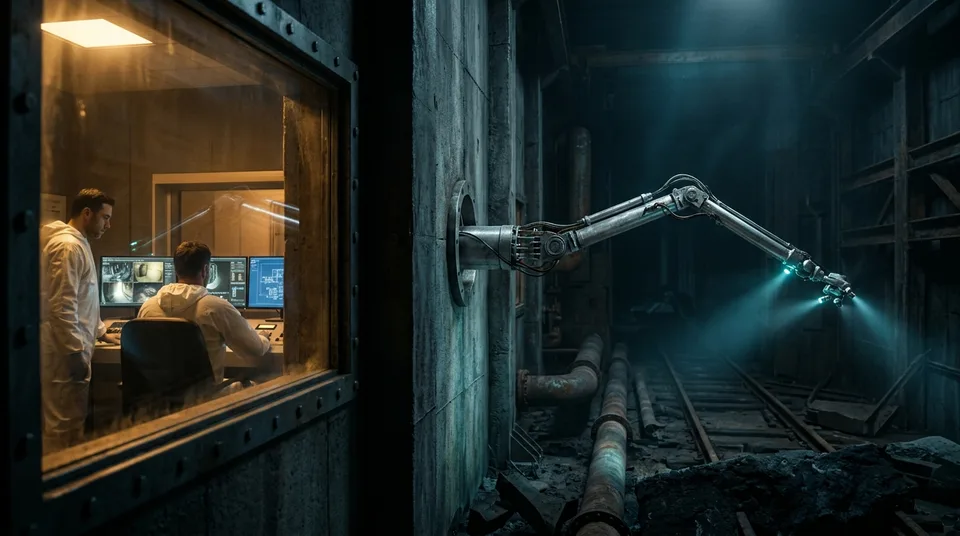
Inside the reactor building of Fukushima Daiichi Unit 2 sits a steel box nearly nine meters long. It weighs roughly 30 tons and it is sealed so that nothing radioactive can leak back out [3].
Folded inside is a robot arm. Stretched out, it reaches about 22 meters, the height of a seven-story building lying on its side. It weighs 4.6 tons [1][3].
To do its job, that arm has to slide through an opening in the reactor's containment wall, a hole called the X-6 penetration. In places, the clearance between the arm and the edge of that hole is only 10 to 20 millimeters, about the width of a finger [3].
Nobody stands beside it. The operators steer from a distance, watching 3D models and virtual-reality views built from the arm's eight cameras [3].
On October 2, 2026, after nearly a decade of development and years of delays, the arm started work [1][2].
Its ultimate target sounds almost absurdly small. The next sample it hopes to bring out is expected to weigh a few grams [2]. The reactors around it hold an estimated 880 tons of melted fuel [6].
That gap, between grams and tons, is the whole story of Fukushima's cleanup.
A place built to keep people out
In March 2011, an earthquake and tsunami knocked out cooling at Fukushima Daiichi and the fuel in three reactors melted. What was left is "fuel debris": uranium fuel fused with steel, concrete and other structural material, now scattered through Units 1, 2 and 3. Unit 2 alone holds an estimated 237 tons of it [6].
That material is still intensely radioactive. Workers cannot enter the containment vessels where it lies, so every step inside has to be taken by a machine.
Radiation is hard on machines too. It degrades electronics and cameras suffer first. When a smaller, telescoping retrieval device went in during 2024, two of its four cameras failed within days. TEPCO, the plant's operator, suspected that radiation had built up an electrical charge in the camera electronics [6].
The schedule shows how hard this is. Removal of the debris was originally meant to begin in 2021 [6]. A first test retrieval of a tiny sample ran about three years behind schedule [7]. Japan's government and TEPCO aim to finish decommissioning by 2051. Yet TEPCO says large-scale removal at Unit 3 will need 12 to 15 years of preparation, which pushes its start to 2037 or later [7].
This is also an energy story. In early 2026, TEPCO restarted a reactor at its Kashiwazaki-Kariwa plant, its first restart since the accident, while the Fukushima cleanup carries on in parallel [8]. How fast and how safely the debris can be handled will shape how people judge nuclear power's long-term costs.
So why does a single arm matter? Because it is the first tool designed to go deeper and stay longer than anything sent in before.
Nine years to the starting line
Here is what has been confirmed so far, from TEPCO's own documents and independent reporting.
- Work began on October 2, 2026. TEPCO announced the start the day before. For the first three to four months, the arm will clear an access route, look around inside the containment vessel and collect 3D data on its shape. The whole campaign should take about six months and TEPCO says it may run longer because safety comes first. The company expects to attempt an actual debris grab with the arm in 2027 or later [1].
- The arm is built for reach, not strength. It was developed from 2017 by Japan's International Research Institute for Nuclear Decommissioning (IRID) with Mitsubishi Heavy Industries and the UK's Veolia Nuclear Solutions [6][9]. It can bend and turn in 18 independent ways (engineers call these degrees of freedom), is made mostly of stainless steel and aluminum and ends in a gripper with two pincers about 5 square millimeters each [6].
- It must cut before it can grab. Old rails and cables block the route. The plan is to slice them away with high-pressure water jets [2].
- It is designed to fail gracefully. TEPCO reports that its cameras are less radiation-tolerant than the doses expected inside, so they will be replaced remotely as they wear out. Motor current and wiring resistance are monitored to catch faults early. If something breaks, the team can force the arm back out or cut off a damaged tip [3].
- The road has been bumpy. In tests, water spray seeped into a connector and caused a communications error, fixed by sealing it [4]. This summer, a locking mechanism on joint No. 3 refused to release. Electrical checks found nothing, so TEPCO presumed a mechanical jam and put the schedule under review [5].
So far, two earlier retrieval rounds with the smaller telescoping device have brought out about 0.9 grams of debris in total [2]. Those crumbs, analyzed at a Japan Atomic Energy Agency laboratory in Ibaraki, are the only pieces of the melted cores that scientists have been able to hold [6].
Why grams come before tons
It is tempting to read "a few grams out of 880 tons" as a sign of failure. It is closer to the opposite.
Think of a surgeon who must operate in a room she has never seen, with the lights off. Before cutting, she wants a map and a biopsy. The arm's first months are the map: 3D data on what the inside of the containment vessel actually looks like after 15 years [1]. The samples are the biopsy. Their hardness, chemistry and radioactivity tell engineers what kind of tools, containers and storage the full-scale removal will need.
That is the non-obvious point. The arm is less a shovel than a scout.
The honest caveat is time. Every step at Fukushima has run late and the reasons are mostly physics and engineering, not carelessness. The plan to begin removal in 2021 slipped because of the pandemic and repeated equipment problems [1][6]. TEPCO's own preparation estimate for Unit 3 now runs into the late 2030s, which casts doubt on the 2051 finish date. Some experts estimate the full job could take more than a century [7].
There is also a limit to what any robot can promise. This arm's summer jam came from a mechanical part, not a software bug [5] and its predecessor lost cameras within days [6]. Machines inside a damaged reactor wear out and every repair has to be done remotely.
One more thing deserves to be said clearly. This is not a story of robots taking human jobs. The arm exists because no person can safely do this work at all. People still plan, monitor and repair; the machine simply goes where they cannot.
The route, in one picture
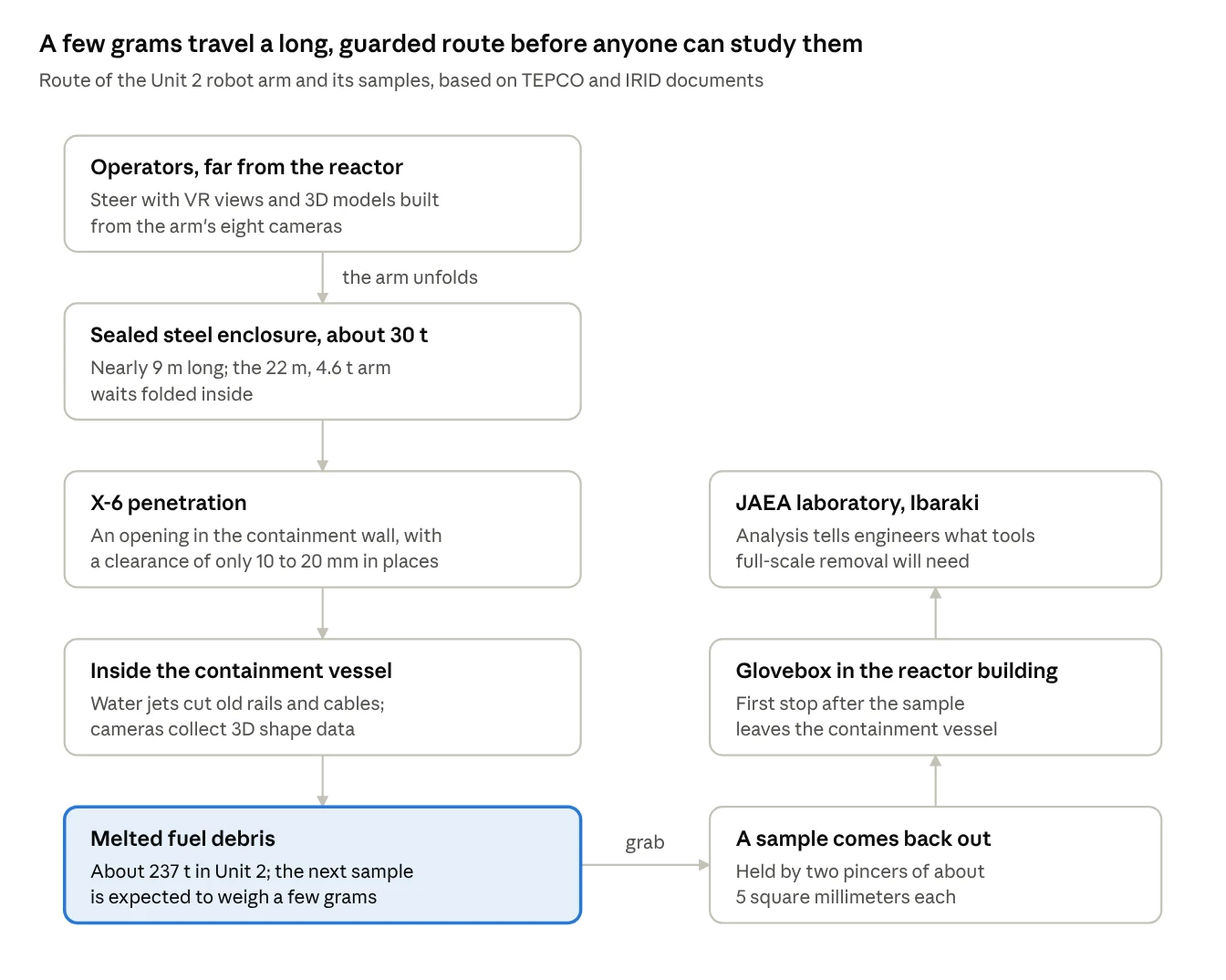
Every sample makes a two-way trip: the arm threads a finger-wide gap to reach the debris and what it grabs goes to a glovebox and then to a laboratory before it can inform the next step [1][3][6].
Imagined futures
The reactor that has a twin. The 3D data the arm collects could grow into a living digital model of the containment vessel, updated after every pass. Engineers would rehearse each cut on the model before the real arm moves, much like the city-scale digital twins explored in The Planet in the Mirror, where planners try ideas on the model before touching the real thing.
Eyes that change themselves. Today, worn-out cameras are swapped remotely by people [3]. A future arm might carry a small magazine of spare camera modules and change its own "eyes" on a schedule set by the dose it has absorbed, like a diver switching air tanks before they run dry.
A machine that hears itself failing. TEPCO already watches motor current and wiring resistance for early signs of trouble [3]. Paired with AI trained on every hour the arm has run, those signals could warn of a jammed joint days before it locks, turning surprises like this summer's into planned maintenance.
From scout to swarm. The arm opens the road; smaller machines could follow it. TEPCO has already announced plans for hand-sized drones to inspect parts of Unit 3 [8]. One can imagine a division of labor: the big arm carries heavy tools, while small flyers and crawlers map corners it cannot see.
A shared toolkit for every old reactor. Dozens of nuclear sites around the world will eventually need dismantling. Tools, software and lessons proven inside Fukushima's harshest rooms could become a common kit for gentler jobs elsewhere, the way spaceflight hardware later found its way into hospitals.
Patience, measured in millimeters
Go back to the steel box in the reactor building. For the next few months, the arm inside it will mostly look, cut and measure. It will not make headlines with tons of debris. If all goes to plan, its first real grab is still a year or more away [1].
That can sound slow. But in a place where a 10-millimeter misjudgment means a stuck arm and a stuck arm means a repair no human can reach, slowness is a design choice.
The takeaway is simple. At Fukushima, robotics is not about replacing people or moving faster. It is about extending human judgment into a space that would kill the humans exercising it. Every gram that comes out teaches engineers how to handle the next ton.
If the arm works, it will join a growing family of machines in this series that do careful work in places we cannot easily be, from the shop-floor helpers in The Robot in the Next Aisle to the tireless experimenters in The Lab That Never Sleeps.
Next in the series: from a reactor where every gram must be coaxed out, to capsules designed to fall from orbit carrying medicines grown in weightlessness, in "The Factory That Falls From the Sky."
References
All sources were opened and checked on October 27, 2026. Specifications and schedules from TEPCO and IRID are company-reported.
- Japan Atomic Industrial Forum, "TEPCO Begins Work toward Fuel Debris Retrieval Using Robotic Arm at Fukushima Daiichi", October 6, 2026.
- nippon.com (Jiji Press), "TEPCO Begins Probe inside Meltdown-Hit Fukushima Reactor", October 2, 2026.
- IRID and TEPCO, "Unit 2 PCV Internal Investigation/Status of Fuel Debris Trial Retrieval" (PDF), February 26, 2026.
- IRID and TEPCO, "Unit 2 PCV Internal Investigation/Status of Fuel Debris Trial Retrieval" (PDF), April 23, 2026.
- IRID and TEPCO, "Unit 2 PCV Internal Investigation / Status of Fuel Debris Trial Retrieval" (PDF), July 30, 2026.
- IEEE Spectrum, "How a Robot Is Grabbing Fuel From a Fukushima Reactor", October 2024.
- South China Morning Post (Associated Press), "Fukushima debris removal delayed until 2037 or later", July 30, 2025.
- American Nuclear Society, Nuclear Newswire, "New PM, restarts, ongoing cleanup on 15th anniversary of Fukushima accident", March 11, 2026.
- Interesting Engineering, "New 72-foot robot arm to clear nuclear debris at Fukushima plant", February 26, 2026.