Three in the morning and the lab is busy
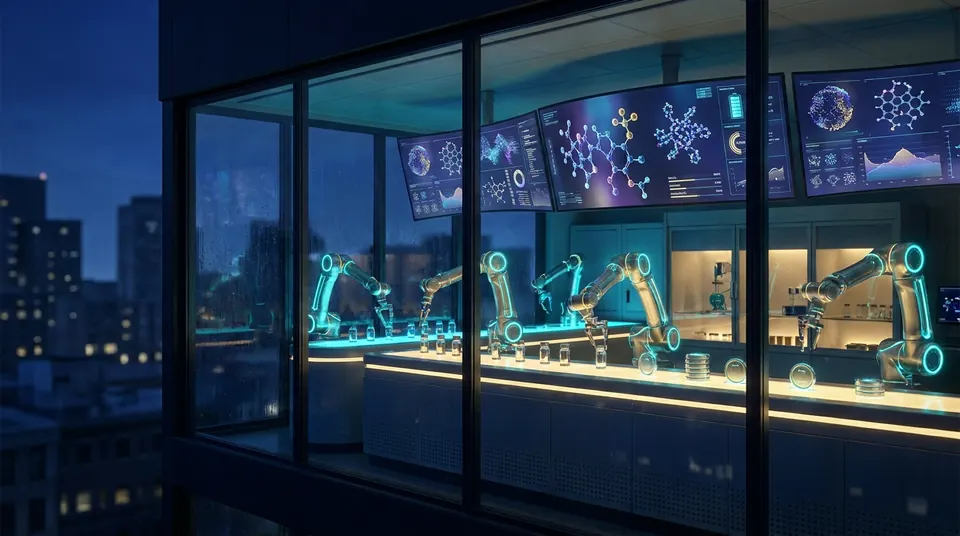
It is 3 a.m. The building is dark, the car park is empty and the coffee machine is off. In one laboratory, a robotic arm lifts a small crucible of powder, slides it into a furnace and sets a timer. Down the hall, an X-ray instrument hums as it reads the crystal structure of yesterday's sample. A computer studies the result, decides the recipe was nearly right, adjusts two ingredients and queues the next attempt.
No human will look at any of this until morning.
This is a self-driving lab: a laboratory where artificial intelligence chooses the experiments and robots carry them out, around the clock. Its most urgent mission is one that ties together everything in this series: finding better materials for the batteries that will power our cars, steady our grids and keep data centers running.
A needle in a cosmic haystack
The lithium-ion battery in your phone took decades to travel from early lab experiments to the shelf. Much of that time went into slow, patient trial and error: mix, heat, measure, think, repeat.
The problem is the sheer size of the search. Combine a handful of elements from the periodic table in different proportions and crystal arrangements and the number of possible materials explodes into the millions, then billions. Only a tiny fraction will be stable and fewer still will move ions quickly, survive thousands of charge cycles, avoid catching fire and avoid scarce metals.
Computers have helped for years by predicting which materials should be stable. That created a new bottleneck. Simulations can propose candidates far faster than human chemists can make and test them. A self-driving lab aims to close that gap, so the experimental half of science can finally keep pace with the computational half.
The stakes are concrete. Lithium is expensive and its supply is concentrated in a few countries. Liquid electrolytes in today's batteries are flammable. A material that uses less lithium, or replaces the liquid with a safer solid, would ripple through every swap station, grid battery and electric car described earlier in this series.
What the robots have already done
Self-driving labs have moved from concept to working machines in only a few years:
- The 32-million-candidate funnel. Microsoft and the US Pacific Northwest National Laboratory (PNNL) used AI models to screen 32.6 million hypothetical materials for a new solid battery electrolyte, keeping about 500,000 that were predicted to be stable [1]. Further rounds of AI and supercomputer simulation cut the field to a shortlist of 18. PNNL chemists chose one to make, a sodium-and-lithium compound that uses about 70% less lithium than comparable materials. It still needs extensive testing before anyone can call it practical [2].
- Cathodes in fast-forward. A self-driving lab developed at KAIST in South Korea, using rapid electrical heating to bake its samples, ran more than five times as many experiments as manual work and cut exploration time for a family of battery cathode materials by over 80%. It is being prepared for deployment at a POSCO Holdings research lab [3].
- A robot that builds whole cells. Switzerland's Empa has built Aurora, a platform that mixes electrolytes, assembles battery cells and cycles them, automating the step where promising materials meet real-world testing [4].
- A global network. The Acceleration Consortium in Toronto received 200 million Canadian dollars in 2023 to build an international network of self-driving labs, with partners from Vancouver to Seoul working on battery electrolytes [5].
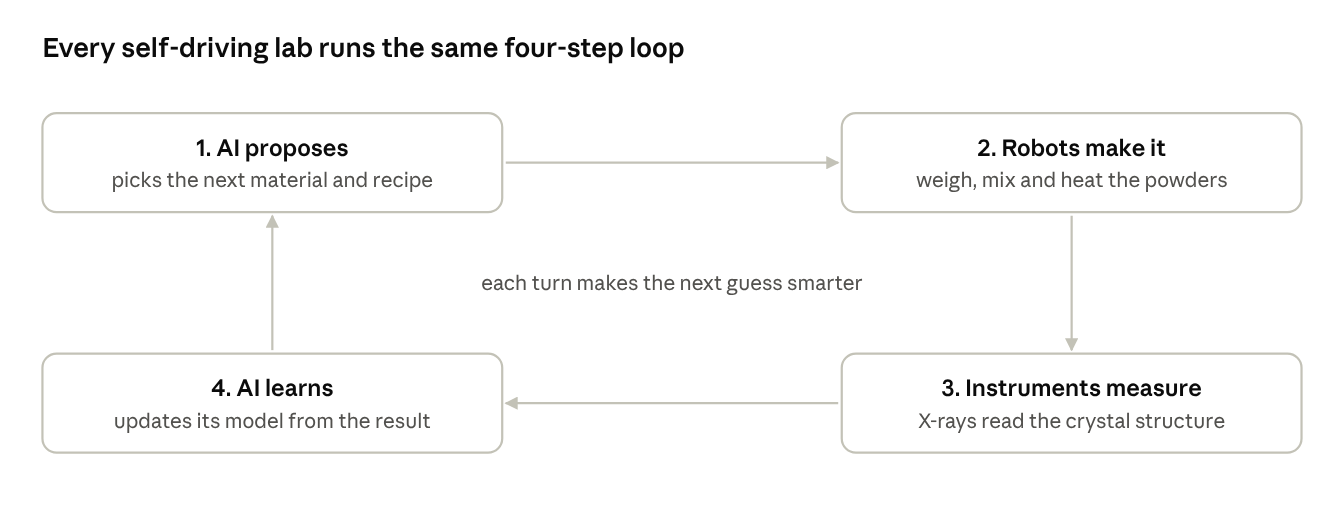
Underneath the different hardware, every self-driving lab runs the same basic loop: propose, make, measure, learn and propose again. Each turn of the loop makes the next guess a little smarter.
The awkward question: what did we actually find?
Every good science story needs a plot twist and this field has a famous one.
In 2023, a team at Lawrence Berkeley National Laboratory unveiled the A-Lab in the journal Nature. Over 17 days of continuous operation, the robotic lab reported making 41 novel inorganic compounds out of 58 targets, many suggested by large computational databases including one built with Google DeepMind [6]. It was hailed as a glimpse of science at machine speed.
Then the crystallographers looked closer. A team including Robert Palgrave of University College London re-examined the X-ray data and concluded that no new materials had been discovered. In their analysis, the software had misread its own measurements and several "new" compounds were known substances or mixtures [7]. The A-Lab's lead author, Gerbrand Ceder, rejected that verdict, said the critique itself contained errors and stressed that the goal had been to show what an autonomous lab could do [8]. Later Berkeley work, described in 2026, more modestly identified a single new crystal made of calcium, ruthenium and oxygen [9].
The lesson is not that self-driving labs fail. It is subtler and more interesting. Making a material is becoming easy for robots. Knowing what you have made and whether it is truly new, is still hard. Identifying a crystal from a blurry X-ray pattern needs judgment that AI has not yet fully earned.
That is why the most credible labs keep humans in the loop at the decisive moments. In the Microsoft–PNNL work, the AI narrowed millions of options to 18, but experienced battery chemists made the final choice [2]. For now, the best self-driving lab is less an autopilot than a tireless research assistant with a very fast pair of hands.
Where quantum fits and where it doesn't yet
Here is a detail worth noticing. The Microsoft–PNNL screening ran on a service called Azure Quantum Elements. Yet the heavy lifting was done by AI models and classical supercomputers running standard physics simulations [1]. The quantum part of the name is a promise about the future, not a description of the work.
That promise is real, though. Batteries work because electrons and ions interact in intricate ways inside a material. Classical computers can only approximate those interactions and the approximations break down for exactly the tricky chemistry battery designers care about, such as how a cathode degrades or how ions hop through a crystal. Simulating electrons is, in a sense, what quantum computers are naturally built for.
The catch is the one described in the first article of this series. Useful chemistry simulations will need error-corrected logical qubits, kept alive by armies of classical processors. Until then, quantum machines can tackle only small molecules that classical methods already handle.
The realistic picture for the coming years is a division of labor. AI proposes, classical supercomputers screen, robots test and, eventually, quantum computers will be called in for the handful of questions nothing else can answer accurately.
Imagined futures
1. The road as a laboratory. Every battery in a swap network is measured each time it is charged and swapped. Imagine those millions of real-world measurements (temperature, wear, charging speed) streaming back to the self-driving lab that designed the battery. The lab would no longer guess how a material ages; it would watch its creations live their lives on the road and redesign the next generation accordingly.
2. The robot skeptic. Today, humans catch the AI's mistakes. Picture a second AI whose only job is to doubt the first: re-analyzing every X-ray pattern, hunting for known compounds in disguise and refusing to sign off on a "discovery" until the evidence is overwhelming. Peer review would begin inside the lab, before a paper is ever written.
3. Labs as a service. What if a small start-up in Eindhoven or Leuven could rent an hour of robotic experimentation the way it rents cloud computing today? Upload a hypothesis in the evening and download results by breakfast. The barrier to entering materials science could drop from millions in equipment to a monthly subscription.
4. Recipes for recycling. The same robots that invent materials could learn to take them apart. A self-driving lab could optimize how to recover lithium, nickel and cobalt from worn-out swap-station batteries, turning yesterday's packs into tomorrow's raw materials and closing the loop on battery sustainability.
5. The quantum consultant. Imagine a lab that, when its AI is unsure about a candidate's chemistry, automatically books time on an error-corrected quantum computer to settle the question. The answer arrives within hours and the robots carry on. Quantum computing would become not a headline technology but a specialist the lab calls in for the hardest cases.
Morning comes
At 8 a.m. the first researcher arrives, makes a coffee and opens the overnight log. Dozens of experiments ran while she slept. Most were dead ends, as most experiments always are. Two look interesting. One looks very interesting.
She leans in to study the X-ray pattern herself. This is where the human still matters most: not in the mixing or the heating, but in the moment of asking, "Are we sure?"
The self-driving lab will not replace scientists. It will change what they spend their days on: fewer hours at the bench, more hours deciding which questions are worth asking and which answers are worth believing. If it delivers, the batteries in tomorrow's swap stations may be invented, at least in part, by a laboratory that never sleeps.
References
The opening and closing scenes are illustrative. The scenarios in "Imagined futures" are the author's speculation and are not drawn from any source. The diagram is an original illustration.
- Microsoft Azure. Unlocking a new era for scientific discovery with AI: How Microsoft's AI screened over 32 million candidates to find a better battery. January 2024.
- Reuters, via iTnews Asia. Microsoft, US lab use AI to speed search for new battery materials. January 2024.
- Materials Research Society. Self-Driving Lab for Next-Generation Battery Materials Discovery. 2025 MRS Fall Meeting abstract.
- Chemspeed Technologies / Empa. Toward an Autonomous Robotic Battery Materials Research Platform (Aurora). 2026.
- University of British Columbia. UBC's Hein Lab and Seoul National University Partnership: Expanding Self-Driving Labs for Clean Energy Innovation.
- Szymanski, N. J., et al. An autonomous laboratory for the accelerated synthesis of novel materials. Nature 624, 86 (2023).
- Chemistry World. New analysis raises doubts over autonomous lab's materials 'discoveries'. 2024. See also Leeman, J., Palgrave, R., et al. Challenges in High-Throughput Inorganic Materials Prediction and Autonomous Synthesis. PRX Energy, 2024.
- The Register. Google DeepMind and Berkeley's AI chemistry research disputed. 31 January 2024.
- Medill Helix, Northwestern University. AI-generated crystals: scientists weigh risks and rewards of automated materials discovery. 21 April 2026.