The fuel station that sells electricity back
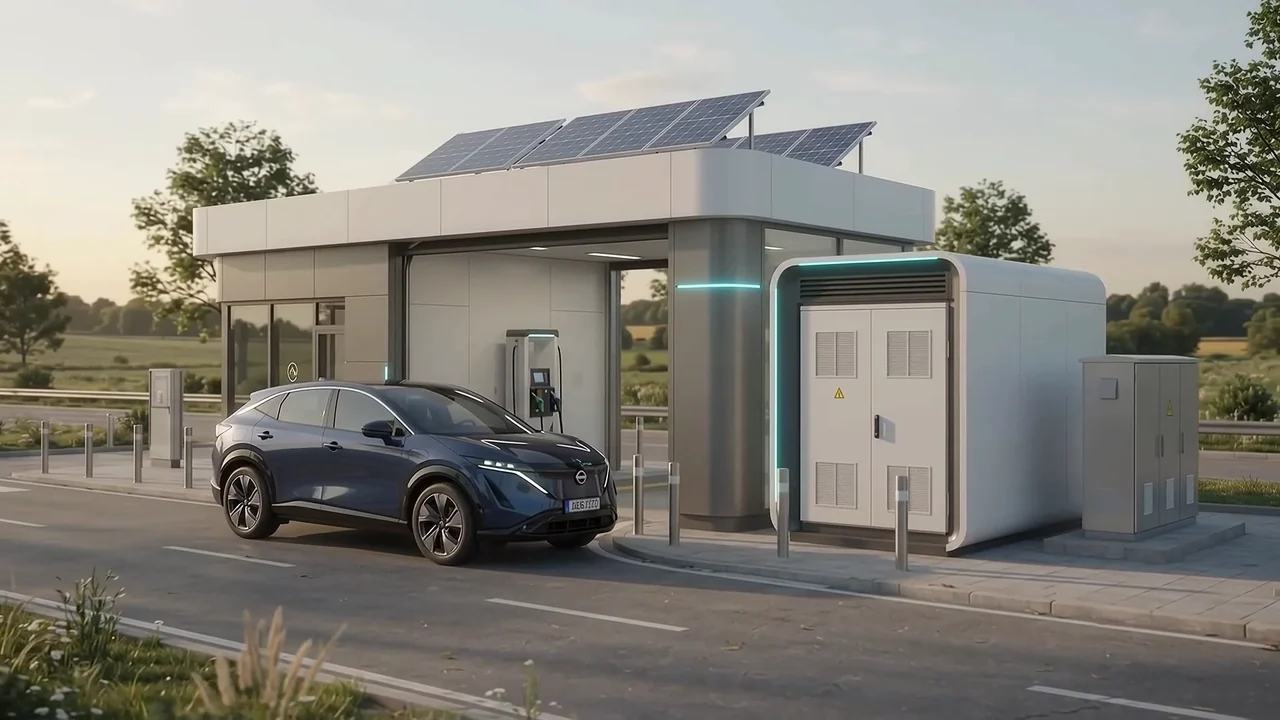
A car glides into a bay. Robotic arms slide underneath, unbolt a half-empty battery and lock in a full one. Less than two minutes later the driver is back on the road, having never touched a cable.
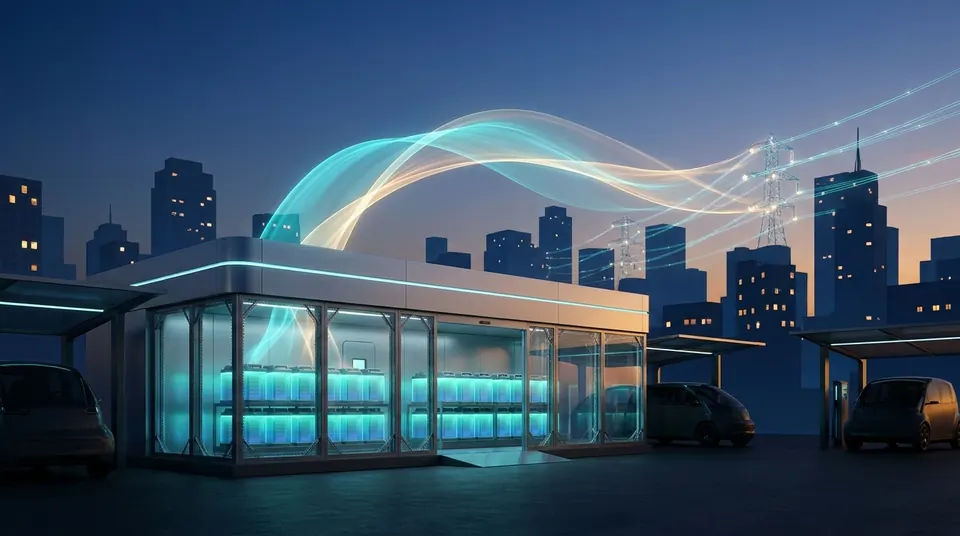
That is the part everyone sees. The more interesting part happens behind the wall. Stacked on racks inside the station sit a dozen charged batteries, waiting for their turn. While they wait, they are doing a second job almost nobody notices: helping keep the electricity grid steady.
A station built to serve impatient drivers turns out to be something else as well: a small power plant on the street corner. In an age when artificial intelligence is pushing electricity demand to new highs, that may matter far more than how quickly anyone changes a battery.
A grid under new pressure
An electricity grid is a balancing act performed every second of every day. Supply must match demand almost exactly. If it drifts, the grid's frequency wobbles and if the wobble grows too large, equipment trips offline.
Two forces are making that balancing act harder at the same time.
The first is artificial intelligence. The International Energy Agency reports that data-center electricity demand grew 17% in 2025, more than five times faster than global demand overall. It expects data-center demand to double by 2030 and AI-specific demand to roughly triple [1]. AI loads are not just big. They can also swing sharply and the IEA notes that this volatility is drawing attention to batteries as a way to smooth supply [1].
The second force is the shift to wind and solar. They are clean and increasingly cheap, but they follow the weather rather than our schedules. A grid built on them needs somewhere to park energy when it is plentiful and draw it back when it is scarce.
Both problems point to the same answer: storage that can respond fast and sits close to where electricity is used. That is exactly where a surprising candidate comes in.
How a swap station becomes a power plant
A charging point is simple: a car plugs in and draws power whenever its driver arrives. A swap station is different. It keeps an inventory of batteries and charges them on its own timetable, which means it can choose when to consume electricity and even give some back.
China has already turned that idea into infrastructure:
- Scale. By mid-September 2026, carmaker NIO had built 4,090 battery-swap stations across China and passed 120 million swaps [2].
- Grid duty. In 2024, NIO and the state-owned utility Huaneng connected 115 swap stations to the Zhejiang grid to provide frequency regulation. By the end of 2025, roughly 860 NIO swap stations were taking part in demand-response, peak-shaving and frequency-regulation markets across 14 provinces and cities [3].
- Speed. Over dedicated 5G links, the stations can respond to grid dispatch commands within seconds [4].
- The trick. While one driver swaps a battery, the station's other ten or so packs can discharge to the grid for several minutes, with hardly any disruption to swap service [5].
NIO is no longer alone. Battery giant CATL launched Choco-Swap, a swap standard shared across many car brands. It had 2,000 stations in 180 Chinese cities by the end of June 2026 [6] and aims for more than 3,000 by year-end, with a long-term vision of 30,000 sites [7]. CATL explicitly describes its stations as distributed energy storage that takes part in peak shaving, frequency regulation and absorbing green power [7].
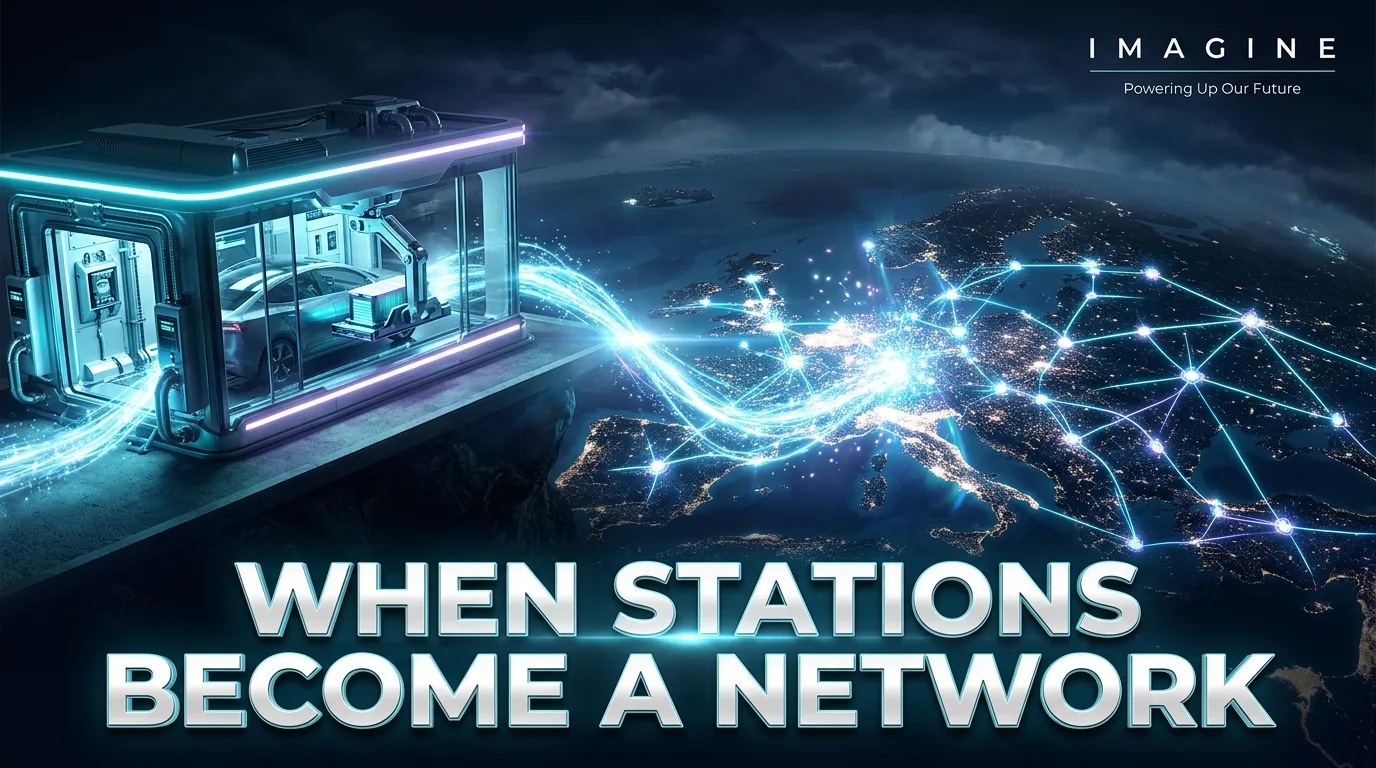
Put simply, thousands of street-corner battery warehouses are being wired together into what engineers call a virtual power plant: no single chimney or turbine, but many small resources acting as one.
A health check at every stop
Packing dozens of high-energy batteries into one building raises an obvious question: is it safe? The swap model's answer is that safety is built into the routine.
Every swap is also an inspection. NIO says its stations check the vehicle's chassis and battery each time a pack is exchanged, so hidden problems can be caught early and a pack showing signs of trouble can be pulled out of circulation instead of going back into a car [10]. The removed packs are then recharged inside the station at controlled currents and temperatures, which is gentler than a rushed fast charge. NIO also says its newer packs are certified so that overheating in one cell does not spread to its neighbors [11]. China has a dedicated national safety standard for battery swapping, GB/T 40032-2021 and a station combines thermal management and fire protection with its robots and chargers [12].
This creates something private battery ownership lacks: a checkpoint at the end of a battery's working life. Because the battery is decoupled from the car, the operator knows each pack's health history and can decide exactly when it should stop being used. NIO argues that this decoupling makes battery recycling easier [10]. A pack that no longer passes inspection doesn't quietly age in a garage. It is taken off the network and sent back to the materials it came from.
The physics of one conversion
There is an elegant bit of physics hiding in the swap model and it concerns losses.
Every time electricity moves into or out of a battery, a little of it is lost as heat. Many ultra-fast charging stations now include their own storage batteries, so they don't overload the local grid. That means energy travels twice: grid to station battery, then station battery to car. It pays the conversion toll twice.
In a swap station, the battery that gets charged is the battery that drives away. The energy goes from the grid into the pack once and the pack goes into the car. CATL calculates that for every 100 kWh drawn from the grid, its integrated swap-and-charge stations deliver about 13 kWh more to vehicles than storage-buffered fast chargers [8]. That is a manufacturer's own calculation and deserves independent testing, but the direction of the effect follows from basic physics.
The money can flow in an unusual direction too. CATL says its stations will pass energy-price differences on to users, potentially earning drivers up to 40 yuan (about 6 US dollars) a day to offset battery lease costs [9]. A fuel station that pays the driver would have sounded absurd a decade ago.
When data centers meet swap stations
Now put the two halves of this story side by side. On one side, AI data centers: huge, power-hungry and prone to sudden swings in demand. On the other, swap stations: racks of batteries that need charging anyway and can shift when they draw power.
As far as public reporting shows, nobody has yet built a site that formally pairs the two. But the logic is hard to ignore and it is worth sketching as a concept: a compute–energy–mobility hub.
Imagine a data center on the edge of a city, with a large swap station next to it and solar panels on every roof. When the AI workload spikes, the swap station briefly slows its charging, or discharges spare packs, so the grid barely notices. When the sun is strong and demand is low, the station soaks up the surplus into packs that drivers will collect the next morning. Every pack would keep passing through the station's health checks and any pack that no longer meets the safety standard would be withdrawn for good: not parked in the data center, but sent for recycling, so its lithium, nickel and cobalt can go into new batteries.
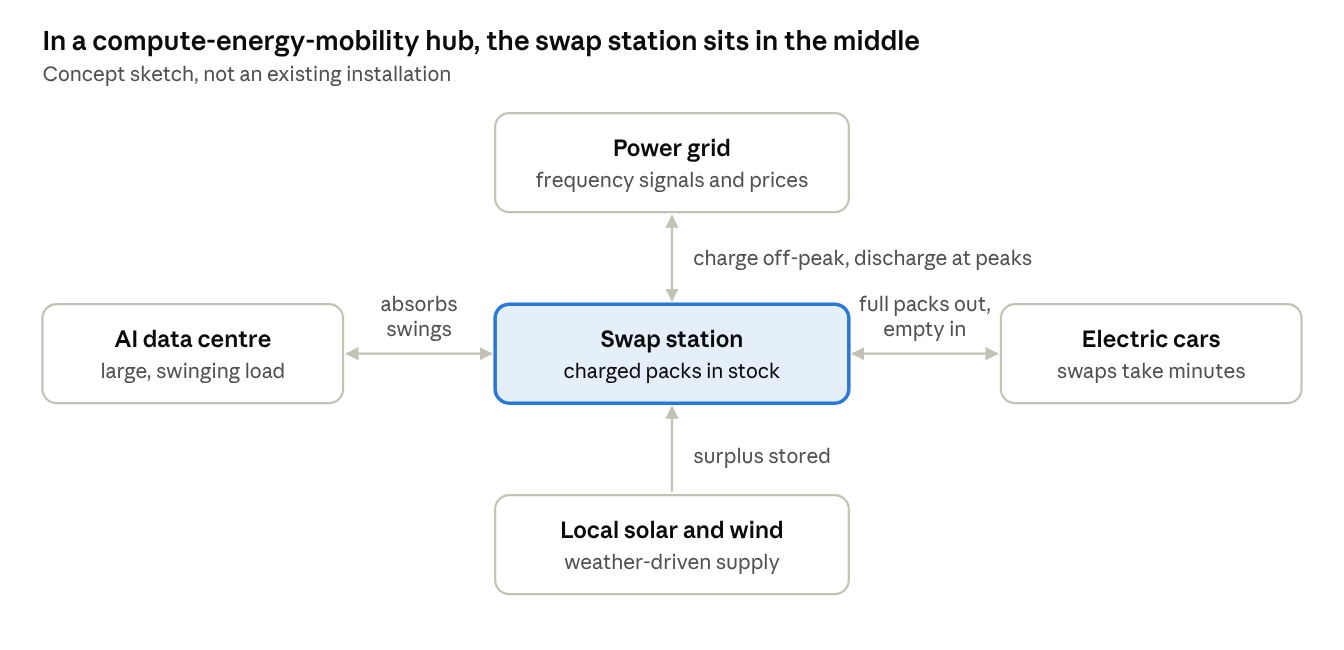
In this picture, a car battery would have two working lives and a clear ending: on the road, on the rack and, once it no longer passes inspection, back to the recycler as raw material for the next generation.
Imagined futures
1. The battery with a weather forecast. Picture a swap network that reads tomorrow's wind forecast, the city's traffic patterns and the AI data center’s training schedule all at once. It decides tonight which packs to fill, which to hold half-full and which to offer the grid at dawn. Drivers notice nothing, except that their swap costs less on breezy days.
2. Packs as a currency. What if a charged battery became a tradable unit, like a barrel of oil but local and instant? Stations, data centers and utilities might swap not only batteries but obligations: "I'll hold 50 charged packs for your evening peak if you power my servers at noon." A new kind of energy market could grow around objects that also happen to carry people to work.
3. The data center that gives way. Flip the direction. Some AI workloads, such as training runs, can pause and resume. A data center linked to a swap network could deliberately slow its training on the coldest, calmest evenings, freeing power for thousands of commuters' batteries. Computing would yield to mobility when the grid is stretched and claim the surplus back when it is not.
4. Europe's version. China built its swap networks first. In Europe, the questions are different: open battery standards across rival car brands and grid rules that let thousands of small stations sell balancing services as one. If those pieces fall into place, the continent's motorway service areas could double as its most distributed power reserve.
5. A quantum conductor. Scheduling tens of thousands of stations, millions of packs and a grid that changes by the second is a ferocious optimization puzzle. Today it runs on classical computers. Tomorrow it might be one of the first everyday problems handed to the hybrid GPU–quantum machines described in the first article of this series. That only happens if they genuinely prove better at it, which is a question worth testing rather than assuming.
Batteries in waiting
We tend to sort technology into tidy boxes: transport here, electricity there, computing somewhere else. The swap station refuses to stay in its box. It is a fuel stop, a warehouse, a battery health clinic, a power plant and, potentially, a shock absorber for the AI economy, all in one building.
The batteries on its racks are never really idle. They are batteries in waiting: waiting for a driver, waiting for a price signal, waiting for the grid to wobble. In that waiting lies a quiet kind of power.
The first article in this series showed how classical chips keep quantum computers alive. This one shows how car batteries might help keep the AI economy's grid steady. The pattern is the same: the breakthroughs of the next decade may come less from any single technology than from the places where they lean on each other.
References
The compute–energy–mobility hub and the scenarios in "Imagined futures" are the author's speculation and are not drawn from any source. The diagram is an original illustration.
Disclosure: a member of the IMAGINE team holds shares in NIO and IonQ. IMAGINE receives no payment from either company.
- International Energy Agency. Key Questions on Energy and AI, 2026, as reported by W.Media: Data center power demand will double by 2030: IEA. 20 April 2026.
- Gasgoo. China Huaneng Group, NIO Power Sign Virtual Power Plant Collaborative Cooperation Plan. September 2026.
- China EV Home. NIO Power, SOE Sign Deal to Bring Battery Swap Stations Into Power Trading. 18 September 2026.
- Gasgoo. China Southern Power Grid, NIO Energy team up on virtual power plant, battery swap station businesses.
- Electrek. NIO tests grid peak shaving at over 100 swap stations.
- Electrifying.com. World's biggest battery firm CATL passes 2,000 battery swap stations in China. 14 July 2026.
- Gasgoo. CATL's Choco-Swap Network Targets Over 3,000 Battery Swap Stations by Year-End. 2026.
- CarNewsChina. CATL's battery-swap stations to feature Shenxing Supercharging with 6-minute full charge capability. 21 April 2026.
- Battery-Tech. CATL Rolls Out Supercharging and Battery Swap Network. 2026.
- CnEVPost. Factbox: What are the advantages of Nio's battery swap system? 21 July 2023.
- Proffitt, K. EV Batteries: Why Charge When You Can Swap? Battery Power Online, 10 June 2026.
- EVKX. Battery Swapping.
Connected in the Universe
Technology domains
Companion episodes