Grid balancing
Respond within seconds to help keep supply and demand matched.
Episode 03 · Published on YouTube
What if stations could work together?
Editorial perspectives: Dali · Ethan — The Challenger
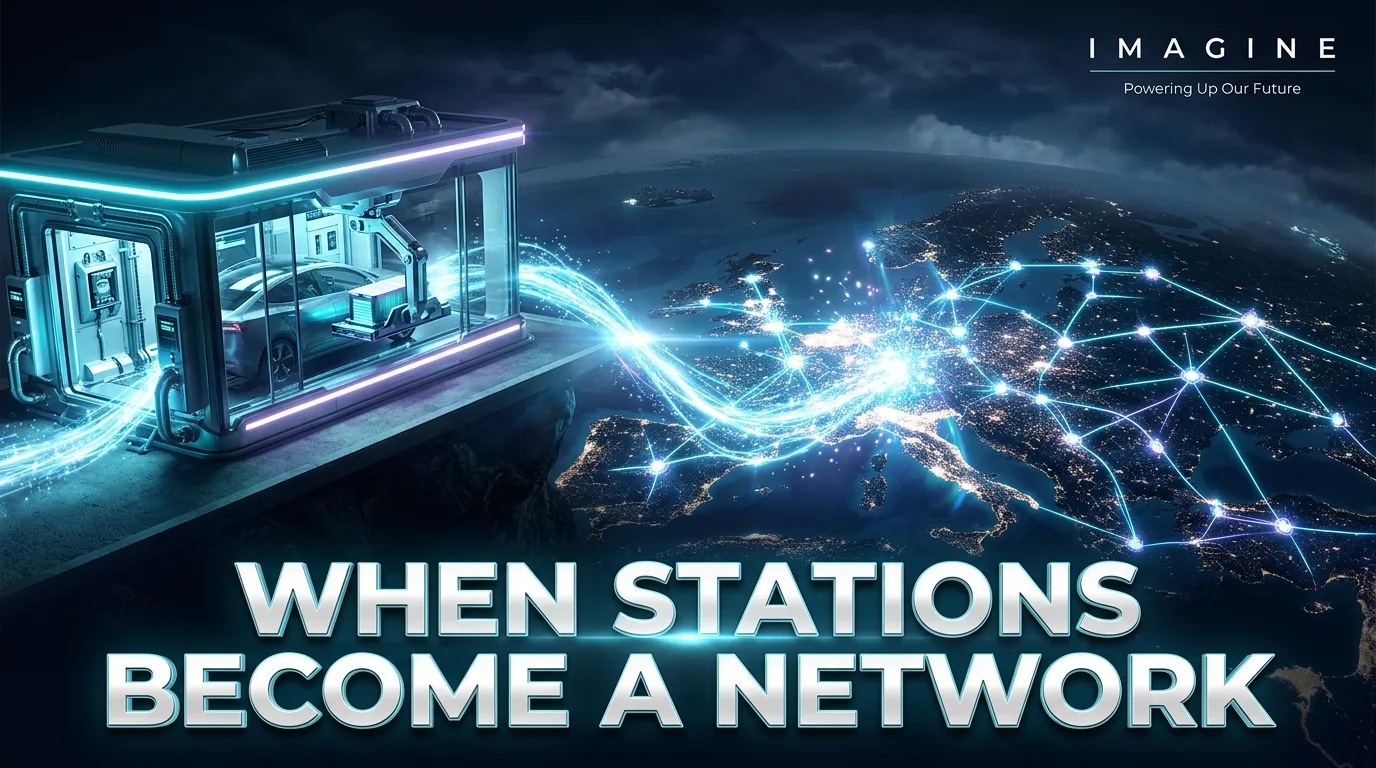
One battery-swap station can store energy and give some back. Episode 003 asks what happens when many stations act as one: a network that keeps drivers moving while helping a grid under new pressure from AI and renewable power.
In the last episode, a single station became a small power plant. This episode asks a bigger question: what if many stations could coordinate, so that the batteries waiting on their racks help steady the grid for a whole region?
Dali connects the systems. Ethan tests the trade-offs. These are the editorial perspectives through which we explore this question.
Published on YouTube · EnterImagine
The player connects to YouTube/Google only when you load it. Playback may use cookies or other storage. You can also watch directly on YouTube.
Electricity supply must match demand almost exactly, every second. Fast-growing data-center demand and the shift to weather-dependent wind and solar both make that balancing act harder, and both point to fast storage close to where power is used.
A swap station keeps an inventory of batteries and charges them on its own timetable. Connected and coordinated, many stations can shift when they draw power or briefly give some back, acting together as what engineers call a virtual power plant.
Because the battery is separate from the car, each exchange is also an inspection. Packs that no longer pass can be taken out of service and sent for recycling rather than quietly ageing in a garage.
Keep enough charged packs ready so that every compatible vehicle can swap and go.
Schedule charging across many stations around available electricity and local limits.
Where rules and equipment allow, shift demand or discharge spare packs when the grid needs support.
Potential applications
Different capabilities, different conditions. The whole system has to work.
Respond within seconds to help keep supply and demand matched.
Store surplus solar and wind in packs that drivers collect later.
Buffer sudden swings from large loads such as data centers.
Track every pack's health and route worn packs to recycling.
What exists today
Networks of battery-swap stations already take part in grid services in parts of China, responding to dispatch signals within seconds while continuing to serve drivers.
What we can imagine
Could coordinated stations become a distributed power reserve for cities, absorbing surplus renewable power and smoothing sudden swings in demand?
Ambition, tested

“But what are we missing?”
Energy Ports are a concept, not an existing product. Grid rules, open battery standards, safety, battery wear and cost decide whether such networks can grow beyond pilots.
Production disclosure
As disclosed with the published video, visuals in this episode are generated with AI. Energy Ports are a concept, not an existing product. Future possibilities are scenarios, not guaranteed outcomes.
Current tools. Experimental workflows. Imagined outcomes.
Operating networks exist in some regions; compatibility matters.
Pilots and markets exist in parts of China; rules differ by country.
Scale, standards and permissions determine what is possible.
A concept, not an existing product.
Keep exploring
What If?