Reliable mobility
Keep transport dependable while planning where and when vehicles need electricity.
Episode 02 · Published on YouTube
What if mobility helped balance the grid?
Editorial perspectives: Dali · Ethan — The Challenger
Electric mobility changes when and where we need electricity. Explore how battery swapping, storage and smart charging could connect reliable transport with a more flexible energy system.
Transport and electricity share a practical question: how do we meet demand in the right place, at the right time? Episode 002 follows that connection from charging vehicles to batteries waiting for their next journey.
Dali connects the systems. Ethan tests the trade-offs. These are the editorial perspectives through which we explore this question.
Published on YouTube · EnterImagine
The player connects to YouTube/Google only when you load it. Playback may use cookies or other storage. You can also watch directly on YouTube.
“Discovery” by Scott Buckley. Released under Creative Commons Attribution 4.0 International (CC BY 4.0).
www.scottbuckley.com.au
Track: https://www.scottbuckley.com.au/library/discovery/
License: https://creativecommons.org/licenses/by/4.0/
Music excerpt edited, ducked beneath narration, and faded.
Cars, vans, trucks and service fleets depend on charging infrastructure. When many vehicles need power in the same place and at the same time, local capacity and scheduling become part of keeping transport reliable.
Solar, wind and other low-carbon sources contribute electricity. Supply and consumption do not always follow the same timetable. Storage and more flexible charging can help connect the two; they do not remove the need for suitable grid infrastructure.
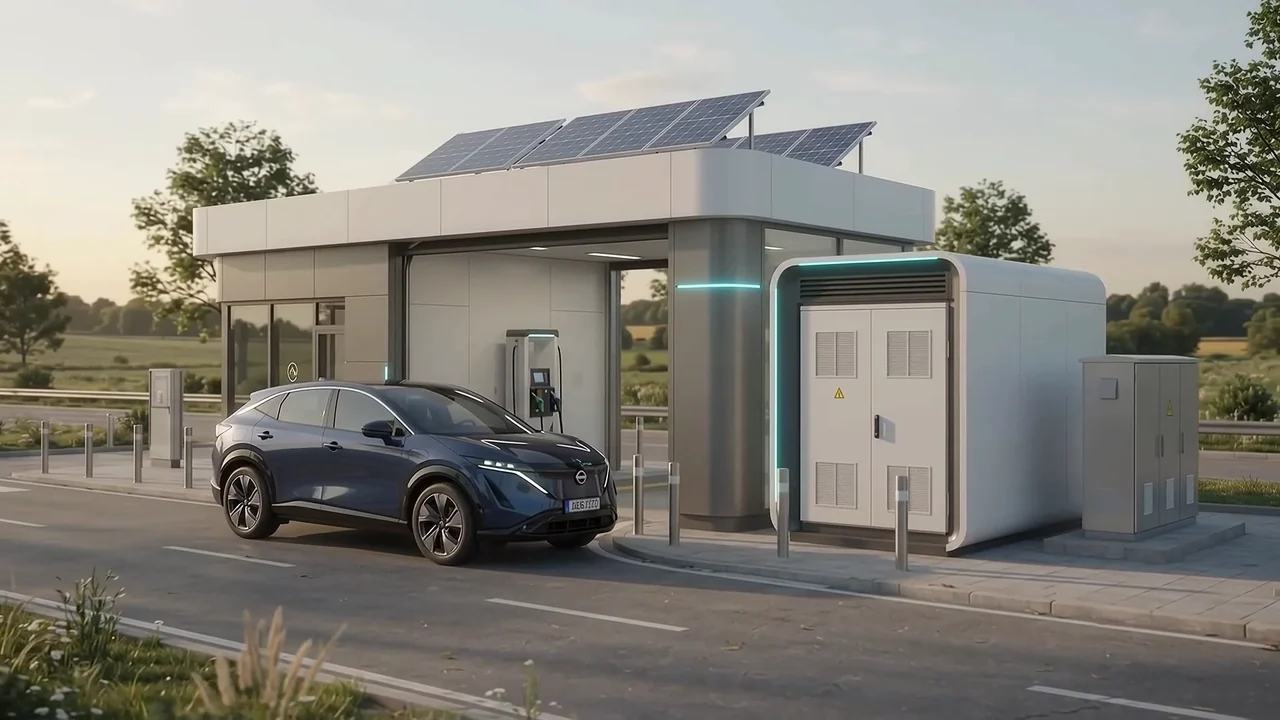
A compatible vehicle can exchange a depleted pack for a charged one. The returned battery stays at the station, where charging can be scheduled while maintaining a supply of ready packs. The episode uses digitally created illustrations; these are not recordings of a manufacturer’s technical procedure.
Maintain charged packs and reliable service for compatible vehicles.
Schedule charging around available electricity, local limits and battery needs.
Where equipment and permissions allow, investigate storage-supported charging or bidirectional grid services.
Potential applications
Different capabilities, different conditions. The whole system has to work.
Keep transport dependable while planning where and when vehicles need electricity.
Shift suitable charging demand without compromising the next journey.
Explore how station batteries could provide flexibility when sufficient reserves remain.
Consider stations as part of a wider system of generation, storage and local grids.
What exists today
Electric vehicles, charging infrastructure and compatible battery-swapping systems already operate. The ability to provide grid services depends on each installation, its equipment and permissions.
What we can imagine
Could coordinated stations charge batteries when supply is available and support the grid while keeping enough packs ready for drivers?
Ambition, tested

“But what are we missing?”
A battery cannot serve every need at once. Ready packs, safety, battery wear, cost and grid permissions determine whether a combined system is useful. Smart charging is another source of flexibility.
Production disclosure
As disclosed with the published video, this episode combines original editing, AI-generated or digitally created illustrations, and educational storytelling. Some visuals are conceptual representations rather than recordings of actual facilities or technical operations. Future possibilities are scenarios, not guaranteed outcomes.
Current tools. Experimental workflows. Imagined outcomes.
Operating systems exist; compatibility and local infrastructure matter.
Capabilities differ between installations.
Equipment, permissions and operating conditions determine availability.
An exploration, not a guaranteed outcome.
Keep exploring
What If?