Drug discovery
Could better molecular calculations help researchers narrow the search for useful compounds? Laboratory and clinical validation would still be essential.
Episode 01 · Published on YouTube
What could become possible when two different ways of computing work together?
With Sofia + Leo · Ethan — The Challenger
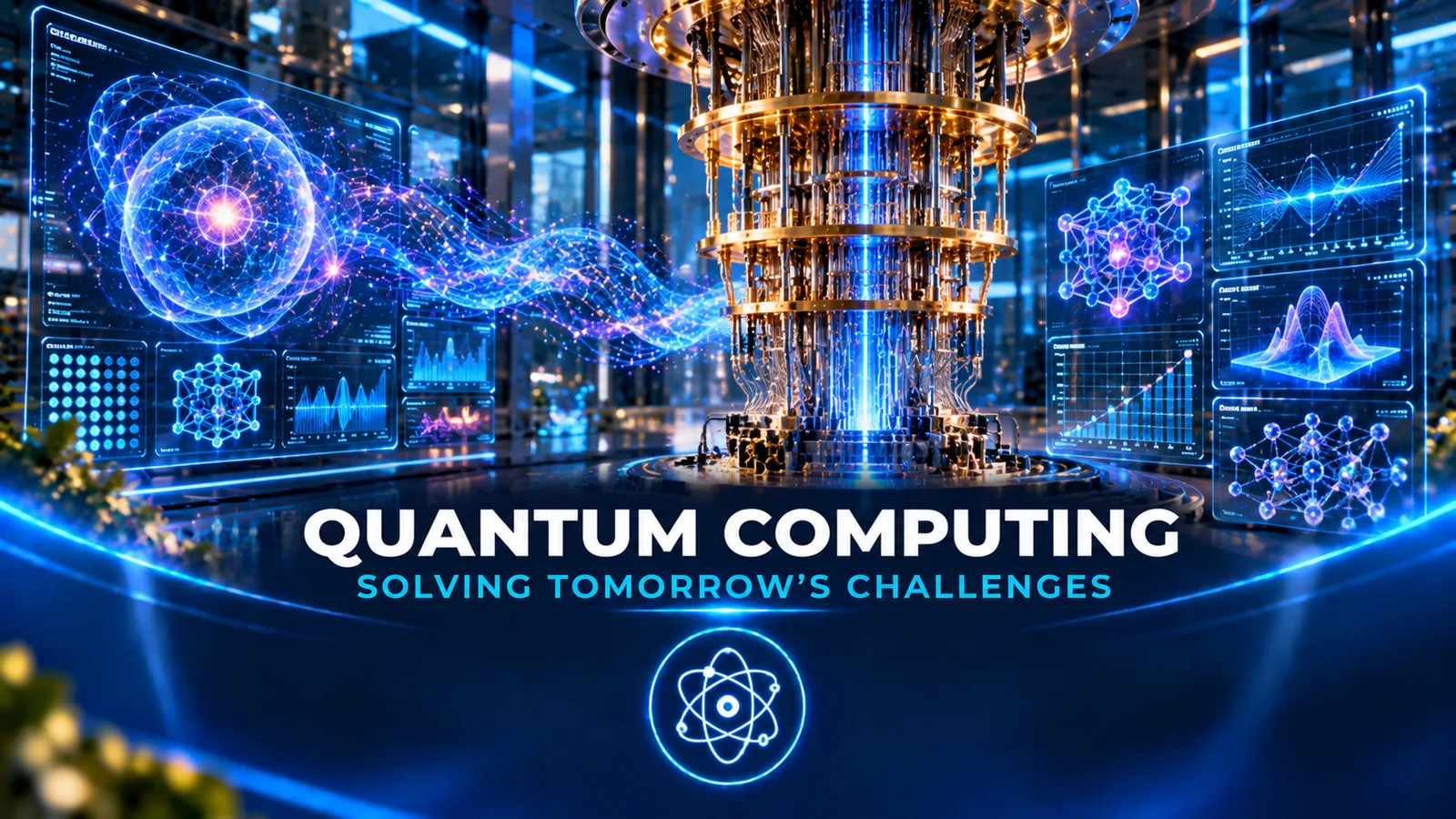
Explore what could become possible when GPU-driven classical computing and emerging quantum computing are combined in hybrid systems.
Some of the questions we care about most — better medicines, cleaner energy, a changing climate — are also difficult to compute. Sofia and Leo explore a possibility: bring different computing strengths into one scientific workflow. Ethan asks what would make that approach useful in practice.
Published on YouTube · EnterImagine
The player connects to YouTube/Google only when you load it. Playback may use cookies or other storage. You can also watch directly on YouTube.
“Discovery” by Scott Buckley — released under CC BY 4.0.
www.scottbuckley.com.au
Track: https://www.scottbuckley.com.au/library/discovery/
License: https://creativecommons.org/licenses/by/4.0/
Music excerpt edited, ducked beneath narration, and faded.
A graphics processing unit, or GPU, is a classical processor designed to do many calculations in parallel. Originally associated with graphics, GPUs also support AI and scientific computing. They remain classical computers: their calculations use ordinary bits.
A quantum processor uses qubits and quantum operations. Carefully designed algorithms use interference to influence which outcomes are measured. Some problems may benefit from this approach; a quantum processor is not a universal shortcut for every difficult calculation.
A classical computer prepares a problem and coordinates the work. GPUs can help with data processing, simulations or classical calculations. A quantum processor runs a selected quantum step; its measurements return to the classical system for analysis and, sometimes, another round. The value depends on the whole workflow, including the cost of moving information between systems.
Classical software organises the data and chooses a problem representation.
CPU and GPU resources handle classical work; a QPU performs a selected quantum calculation.
Measurements return to the classical system, which evaluates and may update the next calculation.
Potential applications
Possible research directions, not demonstrated benefits of this combination.
Could better molecular calculations help researchers narrow the search for useful compounds? Laboratory and clinical validation would still be essential.
Could quantum-assisted simulation reveal promising battery or catalyst materials? Manufacturing and durability would still determine their usefulness.
Could selected hybrid algorithms improve difficult planning problems? They must be compared with competitive classical methods.
Could new materials or better optimisation support cleaner energy? Computing is one part of a wider engineering and adoption challenge.
Could future quantum methods help with particular scientific subproblems? Whole climate models do not become quantum simply by adding a QPU.
Could hybrid tools expand how researchers explore data and models? Useful advantage and reliable results would need to be shown.
What exists today
Hybrid programming tools already coordinate classical and quantum work. GPUs can simulate quantum circuits within classical memory limits, which helps test algorithms. A GPU simulation is not a quantum processor. Experimental hardware and software do not, by themselves, demonstrate a practical advantage for the applications imagined here.
What we can imagine
If reliable quantum steps offer an advantage on selected tasks, a hybrid workflow could become a useful scientific tool. It might help explore molecules, materials or mathematical problems that are difficult today. The right question is where the combination adds value — and whether that value survives real-world constraints.
Ambition, tested

“But what are we missing?”
Ethan asks: where would a quantum approach offer a useful advantage, and what would it cost? Error correction, scale, economics, adoption and ethics all matter. These applications are possibilities to explore, not promised breakthroughs.
Real-world momentum
Hybrid quantum-classical computing is still early, but it is no longer only a thought experiment. Announced partnerships and planned deployments show institutions building infrastructure for real experimentation. The NVIDIA collaboration specifically targets quantum-GPU integration; the FIU agreement expands access to quantum hardware for research and education.
Announced partnership · Planned deployment
Announced
Installation planned for 2027
IonQ announced that Superion 256 is planned to become the first on-premises quantum processor at NVIDIA’s Accelerated Quantum Research Center.
The system is expected to link directly to NVIDIA GB200 NVL72 AI infrastructure through NVQLink, with workloads orchestrated through CUDA-Q. The joint program targets hybrid software development, large-scale system prototyping and quantum-GPU co-design.
The September 2026 announcement schedules installation for 2027. IonQ also expects the first Superion 256 customer deliveries in 2027.
Official IonQ announcement: IonQ + NVIDIA ↗Announced partnership · Planned deployment
Announced
Installation expected in late 2027
IonQ announced a contract to deliver Superion 256 to FIU, selecting the university as its flagship academic partner in Florida. IonQ describes the agreement as the first sale and planned deployment of Superion 256 in the state.
On-campus installation is expected in late 2027, following completion of FIU’s data center. Intended uses include research, education and workforce development.
Expected research areas include materials science, AI, logistics, cybersecurity, health and power grid management. This announcement does not itself establish a GPU-integrated deployment at FIU.
Official IonQ announcement: IonQ + Florida International University ↗These announcements show concrete institutional momentum, not proof of broad, mature commercialization or large-scale quantum advantage. Planned infrastructure makes the path from concept to real experimentation more tangible; installation dates and intended outcomes remain expectations.
Sources reviewed .
Primary sources
Current tools. Experimental workflows. Imagined outcomes.
Classical GPU workloads are already operational.
Tools and research exist; repeatable practical advantage is not assumed.
The potential applications in this episode remain possibilities to explore.
Keep exploring
What If?