A thousand mistakes a second
Picture the most brilliant mathematician alive, with one catch. Every few millionths of a second, she forgets something. A digit flips. A thought fades. To finish any calculation, she needs an assistant at her elbow who spots each lapse and whispers the fix before the next one strikes.
That is a quantum computer in 2026. Its assistant, more and more often, is a graphics processor: the same family of silicon that renders video games and trains chatbots.
For years the headline was rivalry. Quantum machines would make classical computers obsolete. The quieter and truer story is a partnership. Some of the most important engineering in quantum computing is not happening inside the freezer where the qubits live. It is happening in the rack of GPUs standing next to it.
Why qubits need a babysitter
A qubit holds information in a quantum state so delicate that heat, vibration or a stray magnetic field can scramble it. Nobody expects to build a perfect qubit. The plan is to build a reliable one out of many imperfect ones.
This is quantum error correction. One "logical" qubit is spread across a team of physical qubits. The machine never looks at the stored information directly, because looking would destroy it. Instead it runs constant parity checks that reveal whether something went wrong and roughly where.
Think of a building fitted with smoke detectors. You never open the doors. You watch which alarms beep and from that pattern you work out where the fire is. Working out the fire from the alarms is called decoding. A quantum computer must decode continuously, round after round and fast enough that new errors never outrun the fixes.
Here is the twist that changes everything. The bigger the quantum computer, the more alarms there are to read and the harder the puzzle gets. Scaling quantum hardware quietly creates one of the most demanding real-time classical computing jobs ever designed.
Enter the GPU
GPUs are superb at doing thousands of small calculations at once and that is exactly the shape of the decoding puzzle. The last twelve months turned that fit into hardware.
- A dedicated bridge. In October 2025, NVIDIA announced NVQLink, an open architecture for wiring quantum processors directly to GPU supercomputers. Around twenty quantum hardware builders signed on, spanning superconducting, trapped-ion, neutral-atom, photonic and spin-qubit approaches. NVIDIA builds no qubits itself. Its bet is on the connection [1].
- Speed on paper. The link is specified at 400 gigabits per second, with under 4 microseconds of delay between GPU and quantum processor. More than a dozen scientific computing centers have adopted it [2].
- Speed in practice. On its Helios trapped-ion machine, Quantinuum reported a GPU decoder that reacted in 67 microseconds. The machine allowed 2 milliseconds, so the decoder was roughly 30 times faster than required [2].
- AI joins the loop. NVIDIA researchers describe neural-network pre-decoders that clean up most errors locally and pass only the leftovers to a conventional decoder. They report end-to-end decoding in about one microsecond on current GPUs, with fewer logical errors than the conventional decoder alone [3].
A good way to picture the pre-decoder is a triage nurse in a busy emergency room. Most patients need a plaster and are sent home in seconds. Only the hard cases reach the specialist. The specialist's queue shrinks and the whole hospital speeds up.
Some headline figures still deserve caution. NVIDIA reports up to a 347-fold cut in logical errors for one code family, but under benchmark conditions [4]. Smaller firms report AI decoders trained only on simulated noise that still work on real hardware data [5]. Both are promising company claims, not yet independent verdicts.
The microsecond race
What few headlines mention is that the type of qubit decides which classical chip can keep up with it.
Trapped ions and neutral atoms are relatively slow. Their error-correction rounds leave milliseconds to think, which is plenty of time for a GPU. Superconducting qubits, the kind used by Google and IBM, run correction rounds roughly every microsecond. Google's Willow chip, for example, completes one round every 1.1 microseconds [7]. At that pace, even the trip from the freezer to a GPU rack starts to matter.
Specialists such as the UK firm Riverlane argue that the fastest qubits will need decoding in under a microsecond. Their answer is custom chips (ASICs) or reprogrammable logic (FPGAs) sitting right next to the machine, which give fast and perfectly predictable response times. Riverlane has also opened a research team in Delft dedicated to AI for error correction [6]. So the race is less GPU versus custom silicon than a question of who handles which layer.
The most plausible outcome is a three-layer classical stack wrapped around every quantum processor:
- The reflex layer: custom chips beside the freezer, reacting within microseconds.
- The thinking layer: GPUs running AI pre-decoders, recalibrating the qubits as they drift and handling the harder decoding cases.
- The strategy layer: the wider supercomputer, running the classical half of hybrid algorithms and deciding which jobs go quantum at all.
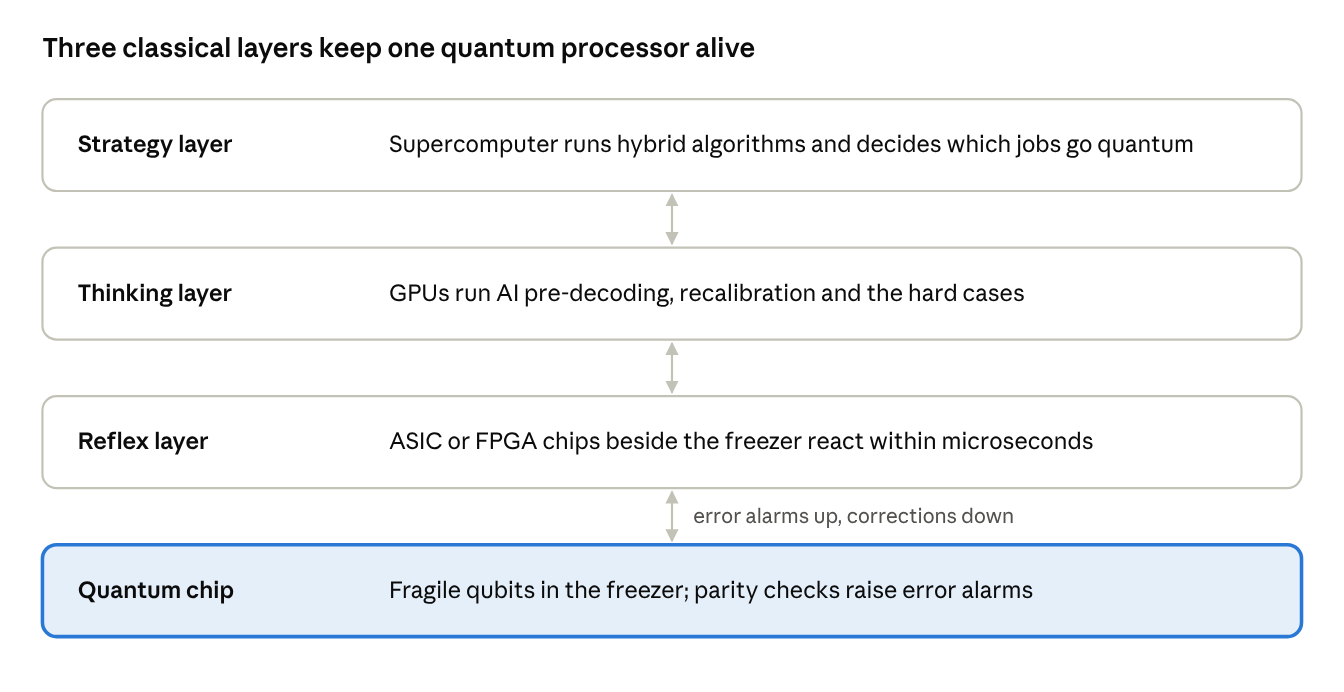
There is a hidden consequence here. Every layer is made of advanced classical chips. Progress in quantum computing therefore depends on the same lithography, packaging and chip design that drive AI. The road to the quantum era runs straight through the semiconductor fab.
The energy question: greener or hungrier?
AI has made electricity a strategic resource. The International Energy Agency reports that data-center power demand grew 17% in 2025 and expects it to double by 2030 [8]. So any new computing paradigm faces a blunt question: does it help or hurt?
Quantum enthusiasts have a seductive answer. Several theoretical studies suggest quantum machines could become cheaper in energy before they become faster in time. One analysis of trapped-ion hardware found that, for a standard quantum algorithm, an energy advantage over today's top supercomputers could appear at around 30 qubits [9]. The reason is that each quantum operation is costly, but certain problems need exponentially fewer of them.
The skeptical journalist's reply is just as important. Those comparisons are idealized, single-algorithm calculations. Nobody yet knows how a large quantum machine's energy use will actually scale [10]. A quantum processor and its refrigerator may draw tens of kilowatts, while the GPU rack correcting its errors can draw far more.
The honest accounting is therefore at the level of the whole system: qubits, cryogenics, control electronics and GPUs together. Hybrid computing saves energy only when the quantum part replaces a large classical workload, such as simulating a molecule that would take a supercomputer weeks. A useful new benchmark would be joules per reliable logical operation. Today, almost nobody publishes it.
Imagined futures
1. The quantum slot in every rack. Imagine a data center where a quantum processor is just another accelerator, the way GPUs joined CPUs two decades ago. A chemist submits a job and never learns which parts ran on qubits. A scheduler quietly routed the hard molecular step to the quantum unit and everything else to GPUs. In this future, the winning quantum company may be the one whose machine is easiest to plug in, not the one with the most qubits.
2. Decoders with a sense of self. Every quantum chip has a noise "personality" that drifts by the hour. Picture an AI decoder that keeps learning its own machine, like an immune system adapting to a body. It would notice that qubit 412 gets jittery on warm afternoons and compensate before errors appear. Calibration would stop being a maintenance chore and become a continuous, self-tuning conversation.
3. Silicon in the deep freeze. What if the reflex layer moved inside the refrigerator, as classical decoding chips designed to run near absolute zero? The wiring bottleneck between warm and cold would shrink dramatically. The line between "quantum computer" and "classical computer" would blur into one cold, layered machine and chip fabs would become quantum suppliers in their own right.
4. The loop runs both ways. Today GPUs serve qubits. Tomorrow the favor might be returned. Quantum machines could simulate molecules and materials that classical methods cannot handle, producing high-quality training data for AI models of batteries, catalysts or medicines. The GPU would keep the quantum computer alive and the quantum computer would teach the GPU's AI.
5. The energy-aware conductor. Picture a supercomputer that, for every task, estimates the cost in joules of each route (quantum, GPU or a blend) and picks the cheapest. Pair it with a smart grid and heavy workloads could wait for the hours when wind and solar are abundant. Computing would start to behave less like a constant load and more like a flexible citizen of the power system.
The partner, not the rival
We like stories about revolutions in which the new thing destroys the old. Quantum computing is turning into a different kind of story, closer to a marriage than a coup.
The qubit brings a strange and powerful new way to compute. The classical chip brings what the qubit lacks: memory, speed, stamina and the patience to correct a thousand small mistakes every second. Neither gets far alone.
So the next time you read that quantum computers will make today's chips obsolete, remember the mathematician with the forgetful mind. Her genius is real. Without the assistant at her elbow, nothing would ever get finished.
References
The scenarios in "Imagined futures" are the author's speculation and are not drawn from any source. The diagram is an original illustration.
- NVIDIA. NVIDIA Introduces NVQLink: Connecting Quantum and GPU Computing for 17 Quantum Builders and Nine Scientific Labs. Press release, 28 October 2025.
- Converge Digest. NVIDIA NVQLink Sees Adoption by National Labs. 2026.
- Chamberland, C. (NVIDIA Research). Fast AI-Based Pre-Decoders for Surface Codes. April 2026.
- The Quantum Insider. NVIDIA Says AI Decoder Achieved up to 347X Cut in Quantum Logical Error Rates. 15 July 2026.
- Quantum Computing Report. Quantum X Labs Outperforms PyMatching Benchmarks on Google Quantum Hardware Surface-Code Dataset Using NVIDIA CUDA-Q. 21 August 2026.
- Riverlane. Why the decoder is the beating heart of quantum error correction. 14 April 2026.
- Google Quantum AI and Collaborators. Quantum error correction below the surface code threshold. Nature, 2024 (arXiv:2408.13687).
- International Energy Agency. Key Questions on Energy and AI, 2026, as reported by W.Media: Data center power demand will double by 2030: IEA. 20 April 2026.
- Energetics of Trapped-Ion Quantum Computation. arXiv:2404.11572.
- Fellous-Asiani, M., et al. Optimizing resource efficiencies for scalable full-stack quantum computers. arXiv:2209.05469.
Connected in the Universe
Technology domains
Quantum ComputingAI & DataEnergy
Companion episode