Special delivery from orbit
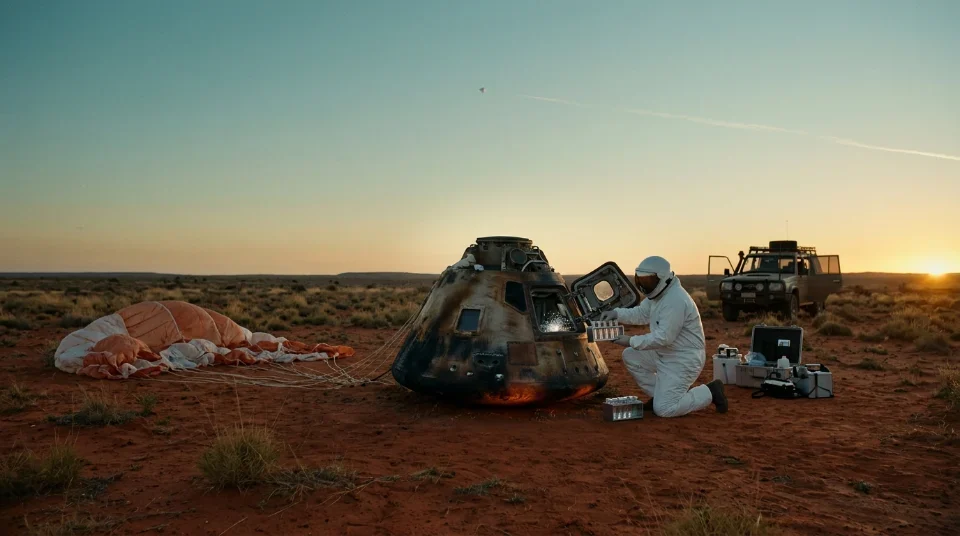
Sometime before Christmas, if the schedule holds, a small blunt-nosed capsule will plunge through the atmosphere at hypersonic speed, glowing behind its heat shield. Then it will come to rest on the Koonibba Test Range, a stretch of remote country in South Australia [5].
It will not be alone. Varda Space Industries, a California company, launched three of these capsules in October: two on October 1 and a third on October 20. All three are meant to come down at Koonibba before the holidays [1][4][5].
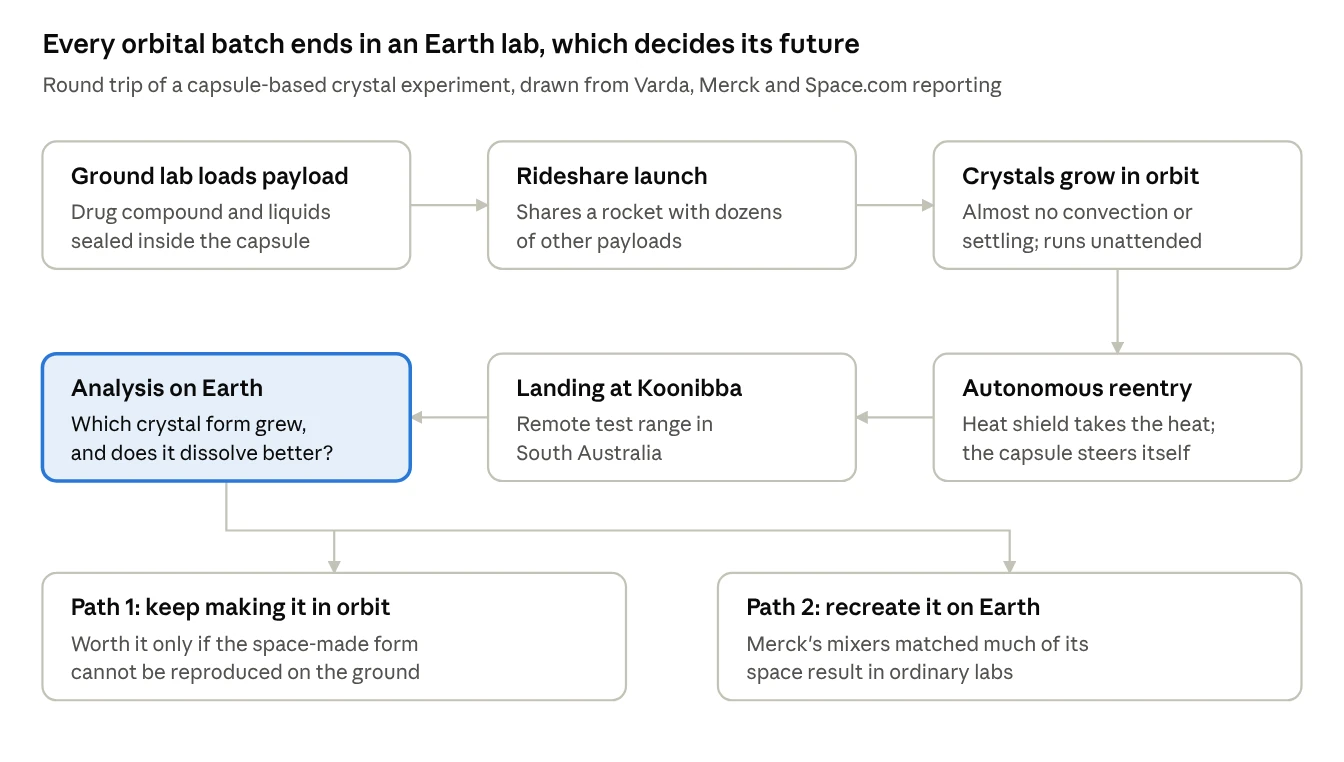
The third one, called W-7, is the one to watch. Inside, a compound from an experimental family of cancer drugs is crystallizing in near-weightlessness. When it lands, those crystals will be analyzed to see whether orbit produced a form that dissolves better than anything made on the ground [1].
On the same rocket rode a much bigger cousin: SpaceX's own return capsule, Starfall, on only its second flight [2][3].
For decades, "factories in space" belonged to science fiction and NASA brochures. This October, the launches started to look like a delivery schedule.
The real question is not whether we can make things in orbit. We can. It is whether anything made up there is worth the trip down.
Gravity, the uninvited ingredient
Picture stirring sugar into iced tea and then watching it. Undissolved grains sink to the bottom. Warmer, lighter liquid rises while cooler, denser liquid falls. On Earth, gravity is quietly rearranging everything in the glass.
The same thing happens when chemists grow crystals. As a crystal forms, it pulls material out of the liquid around it, which changes that liquid's density. Gravity turns the difference into slow currents, a process called buoyant convection. Meanwhile, heavier crystals sink and pile up against the container walls. Both effects disturb growth [9].
In orbit, where everything is in free fall, those currents and the settling nearly vanish. Crystals can grow more slowly and more evenly [9].
Why should anyone care? Because for many medicines, the crystal is the product. The same molecule can pack into different crystal arrangements, called polymorphs and each can dissolve at a different rate. A drug that does not dissolve well in the body is hard to absorb, however clever the molecule [1].
That is exactly the problem with PROTACs, the drug family on board W-7. They are large molecules designed to tag disease-causing proteins for destruction and they dissolve poorly in body fluids. Varda hopes microgravity will yield a more soluble crystal form [1].
The timing matters too. Getting things down from orbit used to be the hard part. Now there are more options: Varda plans seven missions in 2027 alone [5] and SpaceX's Starfall is designed to bring back about 1,000 kilograms of cargo per trip, according to a US regulatory filing reported by Space.com [3]. A factory is only useful if it can ship.
A busy October and a decade of clues
Here is what is on the record and who says so.
- Three capsules in three weeks. Varda put W-8 and W-9 on a single SpaceX rideshare on October 1, its first double launch. The company reports those two carry mostly heat-shield and navigation experiments, several for US defense research programs [4]. W-7 followed on October 20 with the cancer-drug crystals [1]. Varda says it has brought six capsules back safely since 2024 [4].
- The capsules fly themselves home. A capsule does its work in orbit unattended, then steers its own return. In May 2026, Varda's W-6 landed at Koonibba after testing a navigation system that works out its position from images of stars and satellites, the company reports [6].
- A peer-reviewed result on a space-made drug form. Varda's first capsule crystallized ritonavir, an HIV medicine, in orbit, including its least stable crystal form and landed in Utah in February 2024 after months of negotiations over reentry clearance [8]. A study in npj Microgravity, published in April 2026 by the company's scientists and collaborators, reports that this space-made form was recovered with excellent stability [7].
- Semiconductors are next in line. In the UK, Space Forge says its ForgeStar-1 satellite heated an onboard furnace to about 1,000 °C (1,830 °F) and made plasma in orbit, a step toward growing crystals for chips [11]. No crystals have been grown or measured yet. In August, the company signed a research agreement with the Texas A&M University System to grow and test materials on the ground first [12].
- Medicine and fiber on the space station. Redwire and Purdue University ran a pharmaceutical crystal lab on the International Space Station; first crystals came home in February 2026 and a second unit launched in May [13]. Earlier, a fiber-drawing machine on the station produced more than 8 kilometers of a special glass fiber called ZBLAN, the team behind it reported; its promised advantages over ordinary fiber still have to be confirmed on Earth [14].
The pattern is clear: frequent flights, real hardware and a handful of published results. What is still missing is a product people can buy.
The lesson that came back down
The most instructive space-crystal story so far did not end with a factory in orbit. It ended with a mixer on Earth.
In 2017, the drug company Merck sent its cancer antibody pembrolizumab (sold as Keytruda) to the International Space Station. The crystals grown there came out remarkably uniform in size and the resulting suspension was less viscous than the ground-grown version, a useful property for an injectable medicine [10].
Then came the twist. Once Merck's scientists understood why space helped, they could fight the culprits at home. Using rotating mixers to tame settling and temperature differences, they reproduced much of the same uniformity in ordinary labs [10].
That suggests space may be most valuable as a discovery lab rather than an assembly line. You go up once to learn which crystal form is possible, then find a way to make it on the ground.
The business case is still unproven. An analysis in Aerospace America, the magazine of the American Institute of Aeronautics and Astronautics, notes that shipping small experiments to orbit has cost roughly $25,000 to $100,000 per kilogram, so a space-made product must be dramatically better, not slightly better. It also points out that NASA expected profitable orbital factories as far back as 1970 [15].
Schedules slip, too. Astral Materials, a startup aiming to grow silicon crystals in orbit, now lists its orbital flight for 2027 [17], later than earlier reporting suggested [15]. And many in the industry are waiting for much cheaper heavy-lift rockets before they expect real volume [16].
Even the science is not uniformly rosy. In one well-documented pilot, protein crystals formed in 16 of 25 flight samples compared with 12 of 25 on the ground, a modest gain and the authors cautioned that without further tests they could not be sure every crystal was protein [9].
One batch, start to finish
Imagined futures
The crystal atlas. Instead of manufacturing medicines in bulk, capsules could fly hundreds of tiny trial wells per mission, each testing a different recipe. The returned samples would build a shared atlas of crystal forms that only appear without gravity. Chemists on Earth would then use it as a map, the way Merck turned one space result into a ground-based method.
The seed-crystal courier. Some materials might need orbit only at the very beginning. A capsule could grow a near-perfect "seed" crystal in weightlessness and factories on Earth would use it as a template to grow larger crystals, much as a sourdough starter carries a culture from batch to batch.
The robotic shelf in orbit. Today each capsule is a one-shot experiment. A future free-flying platform could hold racks of experiments that robotic arms load into small reentry pods on demand, so a lab could order a batch home the way you order from a warehouse. It would combine the autonomy shown by today's capsules with the robot handling explored elsewhere in this series.
Glass threads for quieter networks. If space-drawn specialty fiber ever proves its theoretical promise of lower signal loss, a few kilograms per year could matter for niche uses such as sensors or medical lasers, long before it could ever replace ordinary fiber in the ground.
A desert delivery route. With more frequent returns, landing ranges in remote regions could become busy logistics hubs, with recovery teams, cold-chain trucks and on-site labs standing by, turning a rare event into a scheduled route.
What the capsule really carries
Back to that empty patch of South Australia. When W-7 lands, the scorched capsule may make a dramatic photo. The real story will be quieter: a set of vials, a lab bench and a question about how a stubborn molecule packs itself together [1].
If the answer is "better than on Earth," Varda will have a reason to keep flying that drug. If the answer is "different and now we know why," chemists may learn to make the new form at home, as Merck did. Either way, something useful comes down.
That is the takeaway. The first real product of space manufacturing may not be a pill or a chip. It may be knowledge that would have been very hard to get any other way.
This series has asked before whether orbit can host industries that strain on Earth, in Can You Cool a Data Center in Space? The answer here is similar: space solves specific physics problems, at a price that only some products can carry.
Next in the series: the space-grown chip crystals in this story depend on a supply chain with surprisingly few doors. "The Narrow Waist of Everything" follows the handful of places nearly every technology must pass through.
References
All sources were opened and checked on October 27, 2026. Mission plans and results from Varda, Space Forge, Redwire and Flawless Photonics are company-reported unless noted as peer-reviewed. As of that date, none of the October capsules had landed.
- Varda Space Industries (PR Newswire), "Varda Space Industries Launches W-7 to Study Cancer Drug Crystallization in Orbit", October 20, 2026.
- Spaceflight Now, "SpaceX launches Starfall reentry capsule, 31 customer payloads on Bandwagon-5 rideshare mission", October 18–20, 2026.
- Space.com, "SpaceX launches its 'Starfall' return capsule for 2nd time ever", October 20, 2026.
- Varda Space Industries (PR Newswire), "Varda Space Industries Launches Two Vehicles to Orbit at the Same Time", October 1, 2026.
- Space.com, "2 spacecraft in orbit and 8 more coming soon: Varda has big plans for in-space manufacturing", October 13, 2026.
- Varda Space Industries (PR Newswire), "Varda Space Industries Successfully Reenters W-6, Validating Autonomous Navigation and Advanced Thermal Protection Systems", May 19, 2026.
- Varda Space Industries, "A study on the stability of ritonavir form III processed in orbit and returned to Earth" (summary of a peer-reviewed paper in npj Microgravity), April 8, 2026.
- Payload, "Varda Releases Results of In-Space Pharma Mission", March 21, 2024.
- PLOS ONE, "A Microfluidic, High Throughput Protein Crystal Growth Method for Microgravity", November 2013 (peer-reviewed).
- ISS National Laboratory, "Published Results From Crystallization Experiments on the ISS Could Help Merck Improve Cancer Drug Delivery", on results published December 2019.
- Gizmodo, "Startup Satellite Hits 1,800 Degrees, Cooks Up Plasma in Orbit for the First Time", January 2, 2026.
- Semiconductor Today, "Space Forge selects Texas A&M University System as manufacturing base", August 17, 2026.
- Purdue University, Davidson School of Chemical Engineering, "Purdue University and Redwire continue space-based pharmaceutical manufacturing research with second ISS launch", 2026.
- Cosmos, "Space manufacturing milestone as 8km of fibre optics made on ISS", 2024.
- Aerospace America (AIAA), "ANALYSIS: The space manufacturing market doesn't yet exist — but some companies say it will soon", October 17, 2025.
- Payload, "The State of ISAM 2026", April 8, 2026.
- Astral Materials, "Missions", accessed October 27, 2026.