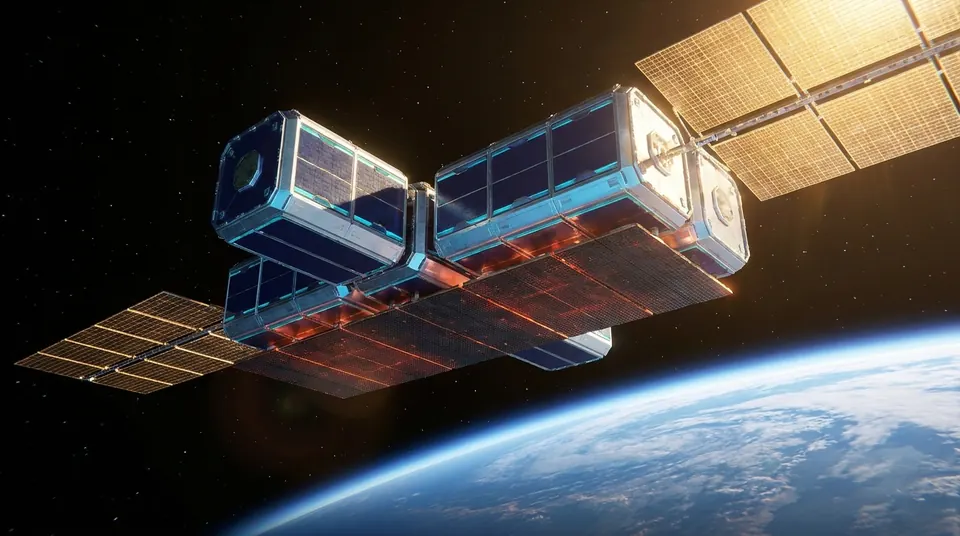
Where the sun never sets
Six hundred kilometers above the Earth, a satellite the size of a small fridge rides the line between day and night, where the sun almost never sets. Its solar panels drink in the light and inside, a graphics processor of the kind that trains AI models wakes up and gets to work.
That is not science fiction. In late 2025, a startup put a top-end AI chip into orbit and ran a language model on it [1]. Google has sketched constellations of AI satellites flying in tight formation [2]. A new phrase is spreading through the tech industry: orbital data centers.
The pitch is seductive. Endless solar power, no land to buy, no grid to wait for, no local opposition. But the more you look, the more one question rises above the rest. On Earth, an earlier article in this series explained how data-center heat might warm our homes. In space, there is no air and no neighbor to take it. So where does the heat go?
Why look up?
AI's appetite for electricity is the starting point. Data-center power demand is expected to double by 2030 [3] and in many places the bottleneck is no longer chips but grid connections, land and permits.
Space offers three tempting answers. First, sunlight. In the right orbit, Google's researchers estimate that solar panels can be up to eight times more productive than on Earth and they shine almost continuously, which reduces the need for batteries [2]. Second, room. Orbit has no zoning boards and no neighbors. Third, timing. Launch prices have been falling for years and Google's analysis suggests that if they drop below about $200 per kilogram by the mid-2030s, a space data center could become roughly comparable in cost to the energy bill of an equivalent one on the ground [2].
That last point is important and easy to miss. The case for orbital computing is not that it works better today. It is a bet that launch costs will keep falling while terrestrial power gets harder to find.
What is already up there
- An AI chip in orbit. In November 2025, the Nvidia-backed startup Starcloud launched Starcloud-1, a satellite carrying an Nvidia H100 GPU. The company reported running Google's open Gemma language model on it and says this was the first time a language model ran on a high-powered Nvidia GPU in space [1].
- Orbital data nodes. In January 2026, Axiom Space launched two orbital data center nodes into low Earth orbit as part of Kepler Communications' optical relay network. They can process data, store it during ground outages and make some decisions on their own [4].
- Google's blueprint. Google's Project Suncatcher, published in November 2025, sketches a cluster of 81 solar-powered satellites carrying its TPU AI chips, flying within a radius of one kilometer about 650 kilometers up, linked by laser beams. In a lab test, one pair of optical transceivers reached 1.6 terabits per second. A proton-beam test found that the chips' memory showed irregularities only at about three times the radiation dose expected over five years with shielding [2].
- Next steps. Google and Planet plan to launch two prototype satellites by early 2027 [2] and Starcloud's second satellite, with more powerful hardware, was scheduled for October 2026 [4].
In other words, there are real chips in real orbits. But today's systems are demonstrations measured in a few processors, not data centers measured in megawatts. Google's own paper lists thermal management among the major problems still to be solved [2]. That is where the real story begins.
A thermos flask with a computer inside
It is tempting to think space is cold, so cooling should be easy. It is the opposite. Space is less like a freezer and more like a thermos flask.
On Earth, heat leaves a server in three ways: by conduction into whatever touches it, by convection as air or water carries it away and by radiation as invisible infrared light. Data centers rely overwhelmingly on the first two: fans, chilled water and cooling towers. In a vacuum, there is no air or water outside the spacecraft. Convection disappears. The only way to dump heat into space is to radiate it and radiation is a slow, gentle process at the temperatures electronics like.
A little physics shows the scale. A perfect radiating surface at about room temperature, 27 °C, gives off roughly 460 watts per square meter, according to the standard law of thermal radiation. That means even an ideal radiator, before any sunlight warms it, needs on the order of a thousand square meters of surface for every megawatt of computing. For comparison, the Copenhagen data center featured earlier in this series is rated at 22.5 megawatts [5], so its space twin would need radiators covering several football fields.
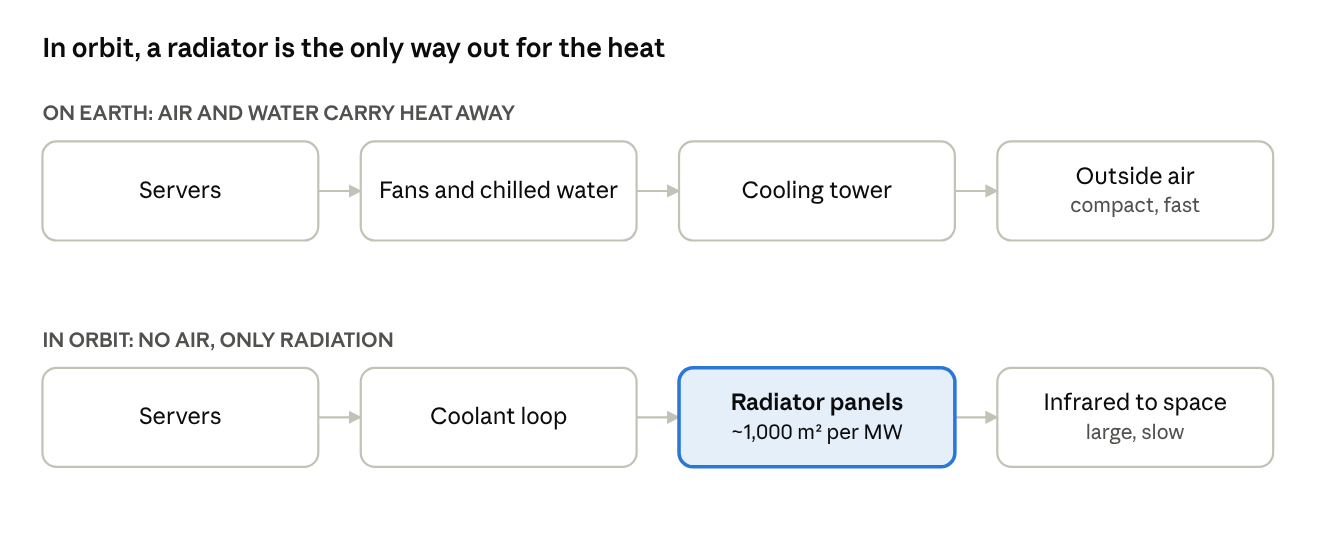
That is why researchers describe radiators that can weigh more than the solar panels themselves, potentially adding very large sums to deployment costs [4]. Starcloud's long-term concept for a 5-gigawatt station assumes solar and cooling panels roughly four kilometers across [4].
There are other hurdles too. Chips must survive radiation, which costs shielding or extra error checking [2][4]. Data must travel to and from the ground through laser or radio links. And nothing can be repaired by a technician with a screwdriver.
None of this makes orbital computing impossible. It makes it an engineering problem dominated by one unglamorous component: the radiator.
Imagined futures
1. Compute where the data is born. Earth-observation satellites already generate huge volumes of images. Picture them processing their own pictures in orbit and sending down only the answers: "a wildfire started here," "this field is flooded." Orbital computing might find its first real market not in training chatbots, but in thinking close to the sensors.
2. Radiators as the new chips. If heat is the bottleneck, the most valuable engineering might shift from processors to radiators: lighter panels, smarter coatings, folding structures. Imagine a future where a space company's edge lies in how well it sheds heat rather than in how fast it computes.
3. Chips that run hot on purpose. Radiation grows sharply with temperature, so a hotter radiator sheds heat much faster. Picture processors designed to run comfortably at temperatures that would be unthinkable in a terrestrial data center, shrinking the radiators needed to cool them.
4. Robots as the space data-center crew. Nobody can send a technician to swap a failed board in orbit. Picture service robots, cousins of the factory humanoids in our previous article, docking with orbital clusters to replace modules and repair radiators.
5. A split brain for AI. Picture AI training that runs where energy is cheapest. Some jobs would run in orbit during long sunlit stretches, others in data centers on the ground that heat homes in winter. Each location would do the work its physics is best at.
Heat always wins the argument
Orbital data centers are a fascinating bet. The sunlight is real, the launches are real and the first chips are already circling the planet. The physics is real too and it is stubborn: in space, heat has nowhere to go except as light, slowly, from very large surfaces.
That makes this the mirror image of our earlier article on data-center heat. On Earth, waste heat is a resource you can pipe into homes. In orbit, it is the enemy you must build football fields of radiators to defeat. Same chips, same physics, opposite problems.
Whether orbital computing becomes a giant industry or a useful niche will depend less on headline-grabbing launches than on quiet progress in launch prices and radiator engineering. Watch the radiators. They will tell you more than the press releases.
References
The opening scene and the scenarios in "Imagined futures" are the author's illustration and speculation and are not drawn from any source. The radiator area is the author's estimate from the Stefan–Boltzmann law of thermal radiation for an ideal surface at 300 K. The diagram is an original illustration.
- OODA Loop, reporting CNBC. Nvidia-backed Starcloud trains first AI model in space as orbital data center race heats up. 10 December 2025.
- Google Research. Exploring a space-based, scalable AI infrastructure system design. 4 November 2025.
- International Energy Agency. Key Questions on Energy and AI, 2026, as reported by W.Media: Data center power demand will double by 2030: IEA. 20 April 2026.
- Introl. First orbital data center nodes reach space: the January 2026 milestone. 2026.
- DatacenterDynamics. atNorth to supply waste heat from DEN01 data center to district heating network in Copenhagen, Denmark. 26 November 2025.