A shift with no coffee break
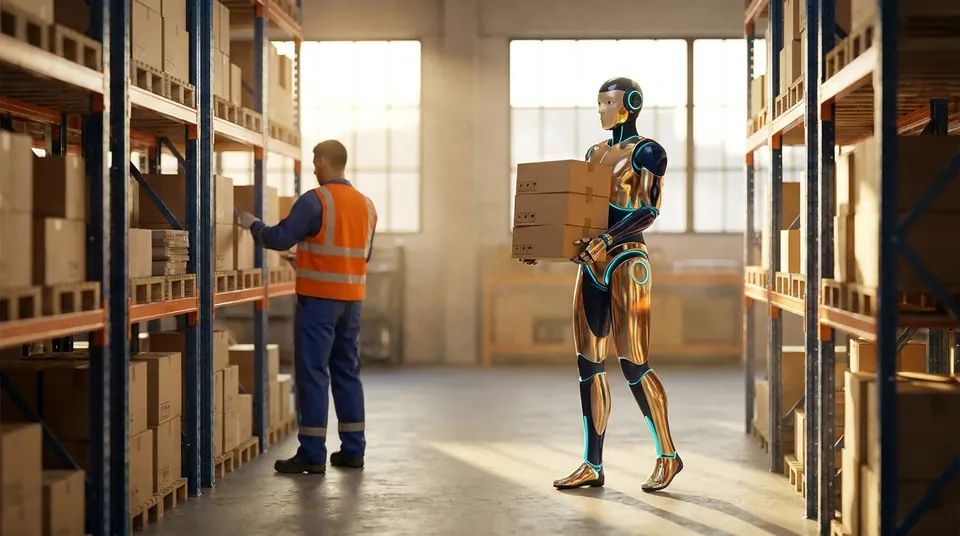
In a warehouse in Georgia, a robot about the height of a person picks up a plastic tote, turns and places it on a conveyor. Then it does it again and again. It does not wave at the camera or do a backflip. It just works through the shift.
Online, humanoid robots dance, fold laundry and serve drinks in polished promotional clips. On real factory floors, the picture is humbler: lifting boxes, moving totes, loading parts into fixtures. Yet these unglamorous jobs are where the technology is quietly proving itself, or not.
The real story of humanoid robots in 2026 is not whether they can amaze. It is whether they can show up, day after day and do something useful without getting in anyone's way.
Why build a robot shaped like us?
Factories have used robots for decades. Welding arms, painting robots and automated carts are everywhere. But they share a limitation: each is built for one job, bolted in place or confined to a fenced area and the factory is rebuilt around it.
The pitch for humanoids is the opposite. Our buildings, tools, shelves and staircases are designed for human bodies. A robot with roughly human proportions could, in theory, slot into an existing line without redesigning it. It could reach the same shelves, push the same carts and switch tasks as needs change.
That promise has become more believable for one reason: AI. The same kind of models behind chatbots are being adapted to see, plan and control robot bodies. Instead of programming every movement by hand, engineers hope to teach robots by demonstration and let them generalize.
There is also a business pull. Many manufacturers struggle to fill repetitive, physically tiring jobs. A machine that could take on the dullest and most awkward tasks is an easy sell, if it works.
What they are actually doing
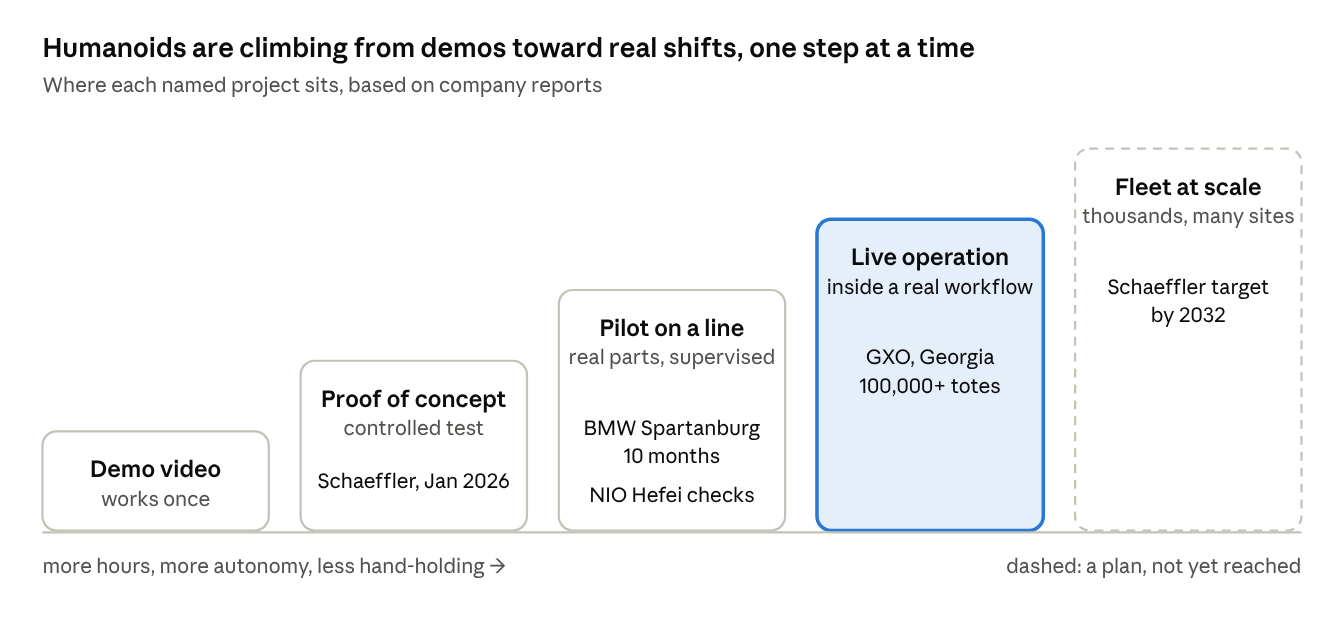
- Totes in Georgia. Agility Robotics says its Digit humanoid has moved more than 100,000 totes at a GXO Logistics facility in Flowery Branch, Georgia. Its work includes taking totes on and off autonomous carts, loading conveyors and stacking containers, as part of a live fulfillment operation [1].
- Car parts in South Carolina. BMW first tested a Figure humanoid at its Spartanburg plant in 2024, placing sheet-metal parts into fixtures for the body shop [2]. Over ten months, the robots logged more than 1,250 hours and moved over 90,000 parts and BMW is now expanding the program, including a test project in Germany [3].
- Quality checks in Hefei. In China, the EV maker NIO was among the first carmakers to put a humanoid on its line. In early 2024, robot maker UBTech showed its Walker S humanoid at a NIO factory in Hefei inspecting door locks, seat belts and headlight covers using real-time cameras and attaching vehicle labels and emblems [6][7]. NIO's head of humanoid robots, Yi Peng, said the company had formed its humanoid team in 2023 and sees logistics, parts assembly and quality inspection as the best-suited jobs for now. He also cautioned that widespread adoption will take a long time [6]. UBTech reports that carmakers including BYD have since ordered its Walker robots [8].
- Boxes in Bavaria. The UK company Humanoid and the German supplier Schaeffler have signed a phased agreement. The first systems are due to go live in Schaeffler's German factories before the end of 2026, starting with box handling. The companies aim for a four-digit fleet across Schaeffler sites by 2032, with assembly and packaging tasks to follow if performance reviews allow [4].
Notice two details. First, the jobs are simple and repetitive: moving containers, placing parts and running visual checks. Second, Humanoid's robots for Schaeffler are wheeled, not walking [4]. The most commercially serious "humanoids" are not always the most human-looking ones.
The numbers are also worth reading carefully. These are company-reported milestones and targets, not independent audits. A hundred thousand totes is impressive for a robot; it is also a modest amount of work for a large warehouse.
From demo to shift
A demo video needs a robot to succeed once, on camera, in a controlled setting. A factory shift needs it to succeed thousands of times, in changing light, around people, without stopping the line. The gap between those two is where most of the hard engineering lives.
The roboticist Rodney Brooks, co-founder of iRobot, is one of the sharpest skeptics. He argues that teaching robots dexterity from videos of humans is wishful thinking, partly because human hands have around 17,000 touch receptors and robots have nothing close [5]. He also warns that walking humanoids pour energy into staying upright and that a fall from a large robot is genuinely dangerous. His prediction: the successful "humanoids" of the future will have wheels, multiple arms and specialized sensors and will have quietly abandoned the human form [5].
The early deployments partly support him. Wheels, simple handling tasks and phased rollouts that hinge on performance reviews are the pattern so far [4]. That is not failure. It is what a young technology looks like when it meets the real world.
There are also questions the press releases rarely answer. How often does a human have to step in? What is the cost per task compared with a conveyor or a cart? How close can people safely work beside a robot that might fall? Until those numbers are published and independently checked, the honest verdict is "promising, unproven at scale."
Imagined futures
1. The robot that learns from the night shift. Picture every robot in a fleet recording its small failures, a dropped tote, a misjudged grip and sharing them overnight. By morning, every robot in every factory has learned from all of them. A fleet of a thousand would gain experience a thousand times faster than one.
2. Hire by the hour. Robot-as-a-service is already the business model for some deals [4]. Imagine a small manufacturer renting two robots for a peak season the way it rents forklifts, paying per task rather than per machine. Automation would stop being a capital project only large firms can afford.
3. The shape follows the job. If Brooks is right, the winners will not look like us. Picture modular robots that swap a torso on wheels for a pair of extra arms, or a long-reach gripper, depending on the morning's task. "Humanoid" might end up describing how robots fit into human spaces, not how they look.
4. A coworker you can read. For people to work beside robots, they need to know what a robot is about to do. Imagine humanoids that signal intent with light, sound or posture, the way drivers use indicators, so a colleague knows to step aside before the robot turns.
5. Robots in the battery loop. The swap stations and recycling lines in earlier articles of this series involve heavy, repetitive and sometimes hazardous handling. Picture robots taking on the dismantling of worn battery packs, keeping people away from the riskiest steps while recovering materials for new batteries.
The quiet test
The most important humanoid robot milestone will not look exciting. There will be no backflip and no viral clip. It will be a spreadsheet showing that a robot worked a full year of shifts, needed help rarely, cost less per task than the alternative and never hurt anyone.
We are not there yet. But robots moving totes in Georgia, placing parts in South Carolina, checking cars in Hefei and handling boxes in Bavaria are the first honest steps up that ladder. Whether the robots that finish the climb still look human is one of the most interesting open questions in technology.
In The Lab That Never Sleeps, robots ran experiments while scientists slept. Here they are learning to share the factory floor with us. Either way, the robots that matter most may be the ones that make the least noise.
References
The opening scene is illustrative. The scenarios in "Imagined futures" are the author's speculation and are not drawn from any source. The diagram is an original illustration; project placements follow company reports.
Disclosure: a member of the IMAGINE team holds shares in NIO and IonQ. IMAGINE receives no payment from either company.
- OODA Loop. Agility Robotics Digit humanoid passes 100,000 tote milestone in live GXO implementation. 24 November 2025.
- BMW Group. Successful test of humanoid robots at BMW Group Plant Spartanburg. Press release, 6 August 2024.
- Automotive News. BMW expands humanoid robot program to Germany. 27 February 2026.
- Robotics 24/7. Humanoid to deploy thousands of its humanoid robots on Schaeffler factory floors. 13 May 2026.
- TechCrunch. Famed roboticist says humanoid robot bubble is doomed to burst. 26 September 2025.
- CnEVPost. Nio exec explains how its factories use humanoid robots. 7 April 2024.
- Inspenet. NIO implements humanoid robots on electric vehicle assembly line. 3 March 2024.
- Interesting Engineering. UBTech to deploy up to 1,000 factory humanoid robots. 27 January 2025.