A drug with one patient
Most medicines are made for millions. They are tested on thousands of volunteers, manufactured by the ton and sold in every pharmacy.
Now imagine a medicine with exactly one intended patient. It is designed around a single misspelled letter in one child's DNA, built in a few months and given to a baby too young to sit up. There is no trial, no comparison group and no second customer waiting.
That is no longer a thought experiment. In Philadelphia, a baby known as KJ received a gene-editing treatment made just for him and he is now meeting his developmental milestones [1][2]. His case is pushing medicine toward a question it has never had to answer before: how do you approve a drug when the whole market is one person?
Too rare to cure
Thousands of diseases are caused by a single faulty gene. Individually, each is rare; together, they are not. The head of the US Food and Drug Administration (FDA) has put the number of Americans living with a rare disease at about 30 million [3].
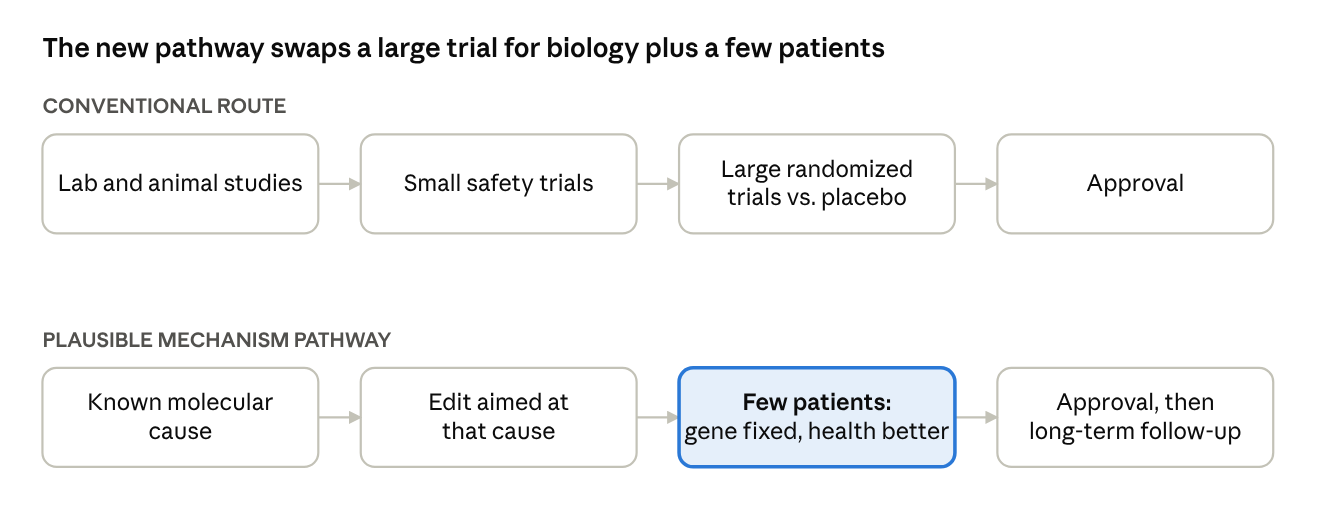
The trouble is that the drug system was built for common illnesses. A conventional approval asks for large trials that compare a treatment against a placebo or an existing drug. That makes sense when there are thousands of patients to enroll. It makes no sense when a mutation is shared by a handful of children worldwide, or by one.
For many families, the result has been a cruel waiting game. The science to fix their child's gene may exist, but no company can justify a decade-long, billion-dollar program for a market of a few patients.
Gene editing changes part of that equation. A tool such as CRISPR, which can find and change a precise spot in DNA, works in a similar way whichever gene it targets. Only the "address" changes. That raises a tantalizing possibility: if the delivery system and the editor stay the same, perhaps each new version does not need to be proven from scratch.
What has actually happened
- Six months, one baby. KJ was born with a rare disorder that left his body unable to clear toxic ammonia from his blood. A team led by Kiran Musunuru and Rebecca Ahrens-Nicklas at the University of Pennsylvania designed and produced a treatment for his specific mutation in about six months [1][2]. It used base editing, a refined form of CRISPR that swaps a single DNA letter rather than cutting the strand [1].
- A gentle start. KJ received a low first dose at seven months old, followed by two higher doses. By late 2025 his parents reported that he was meeting his developmental milestones, though his doctors say they will monitor him for years before judging how well it worked [2].
- From one to a few. The team plans a trial for children with similar disorders. Musunuru says the FDA agreed to a protocol that could involve as few as five patients carrying at least three different genetic variants [2].
- A new regulatory road. In February 2026 the FDA issued draft guidance for a "plausible mechanism pathway" for individualized therapies, such as genome editing and RNA-based treatments, for rare and ultra-rare diseases where randomized trials are not feasible. The agency said the framework was modeled on KJ's treatment, which was for a condition called CPS1 deficiency [3].
Instead of large comparative trials, the pathway asks for five building blocks: a clearly understood molecular cause, a therapy that targets it directly, good knowledge of how the untreated disease progresses, evidence that the target was actually changed and clinical improvement beyond normal variation [4]. Long-term safety data would then be gathered after approval [4].
The hard questions
It is easy to read this as a happy ending. It is better read as a careful beginning.
Evidence. A large randomized trial exists for a reason: it separates a drug's effect from luck, natural variation and wishful thinking. The new pathway replaces that with biological reasoning plus a small number of patients. That is a defensible trade for a fatal disease with no alternative. It also means that some treatments will be approved on thinner evidence than doctors are used to and that rare side effects may only surface later. The pathway's reliance on follow-up data after approval is a feature, but it is also an admission of what is not yet known [4].
Cost. KJ's treatment cost roughly what a liver transplant does, around $1 million. Musunuru expects that to fall to a few hundred thousand dollars per treatment within a few years [2]. That would be a remarkable drop and still far beyond what many health systems can pay for every child who needs one.
Scale. Building one bespoke therapy in six months took dozens of researchers working flat out [1]. Doing it for thousands of patients needs something closer to a factory. Berkeley's Fyodor Urnov and Sadik Kassim argue for testing families of similar treatments together, sharing data and standardizing production, rather than treating each one as an entirely new drug [5].
Access. The first patients will be those near a handful of expert hospitals, in countries whose regulators move first. Whether medicine for one becomes medicine for everyone who needs it is a question of money and policy as much as science.
Imagined futures
1. The editing kit with a swappable address. Picture a treatment where the delivery package and the editor are approved once and only the short guide that tells it where to go changes from child to child. Each new version would be checked like a software update rather than invented like a new drug.
2. AI as the design assistant. Choosing exactly where to edit and predicting what else the editor might touch by mistake, is slow expert work. Imagine AI models that propose the safest edit for a given mutation overnight, with a human team checking the result. The six months it took for KJ might shrink toward weeks.
3. The hospital pharmacy that makes gene editors. Today, specialist manufacturers make these treatments. Picture a regional hospital with a small, highly regulated production room that builds one-patient therapies on site, the way some hospitals already prepare custom medicines.
4. A global registry of one. Each bespoke treatment teaches something. Imagine every case, success or failure, feeding a shared international database, so the hundredth child benefits from the ninety-nine before. Evidence that no single trial could gather would build up patient by patient.
5. From newborn screening to treatment in months. Many rare genetic diseases can already be spotted in a baby's first days. Picture a future in which a positive screening result starts the design of a personalized treatment immediately, so a child is treated before the disease does lasting damage.
One patient, many lessons
For most of history, a rare disease meant waiting for a cure that the market had no reason to build. KJ's treatment did not change the market. It changed the logic: if the tool stays the same and only the address changes, perhaps the proof does not have to start from zero every time.
Regulators have now written that logic into a draft rulebook. That is a big step and an uncomfortable one. It asks doctors, families and regulators to accept more uncertainty in exchange for speed and it leaves the hardest questions about cost and fairness unanswered.
The earlier articles in this series were about machines working together: GPUs and qubits, batteries and grids, robots and AI. This one is about a different kind of collaboration: a lab, a hospital, a regulator and one family, building a medicine for one.
References
The scenarios in "Imagined futures" are the author's speculation and are not drawn from any source. The diagram is a simplified original illustration, not a legal description of either route. This article is for general information and is not medical advice.
- UC Berkeley Letters & Science (republished from Nature). Personalized gene editing helped one baby: can it be rolled out widely? 3 November 2025.
- MIT Technology Review. Base-edited baby and personalized drugs: 10 Breakthrough Technologies 2026. 12 January 2026.
- Healio. FDA provides new approval process for rare disease therapies without large clinical trials. 23 February 2026.
- Parexel. FDA's new 'plausible mechanism pathway': transforming regulatory approval for personalized gene therapies. 10 December 2025.
- Urnov, F. D. and Kassim, S. H. Personalized CRISPR therapies could soon reach thousands — here's how. Nature 652, 857–859 (2026).