A radiator powered by a chatbot
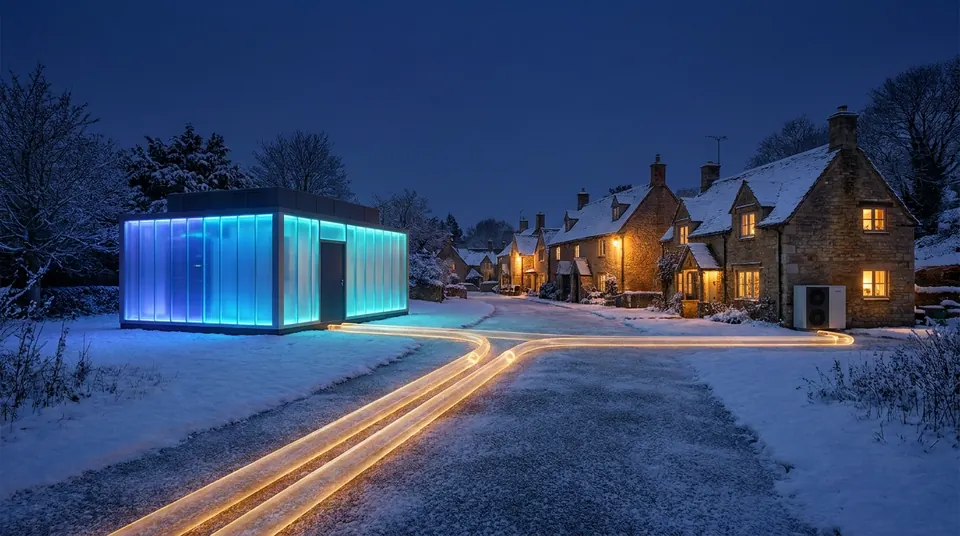
It is a cold January evening on the edge of Copenhagen. In a family apartment, the radiator under the window is warm. Nobody in the room is thinking about where that warmth comes from.
A few kilometers away, rows of servers are answering questions, training models and streaming video. They run hot and the building that houses them works hard to get rid of that heat. Starting later this decade, instead of blowing it into the sky, it is meant to flow through underground pipes into thousands of homes like this one.
The same machines that power the AI boom could quietly become one of the city's boilers. It sounds almost too neat. The physics is real, the projects are real and so are the reasons it is harder than it looks.
Every watt becomes heat
A computer chip does not "use up" electricity the way a car burns fuel. Almost all of the energy that goes into a server comes out again as heat. A data center is, in a very literal sense, a giant electric heater that happens to do calculations along the way.
That used to be a niche concern. It no longer is. The International Energy Agency reports that data-center electricity demand grew 17% in 2025 and expects it to double by 2030, driven largely by AI [1]. Every extra megawatt of computing is also an extra megawatt of heat that has to go somewhere.
Today, most of it is simply thrown away. Chillers and cooling towers dump it into the outside air and they use more electricity to do so. Meanwhile, a short distance away, homes, schools and swimming pools burn gas to keep warm.
So the question almost asks itself: why heat the sky when you could heat a neighborhood?
Where it is already happening
Europe, with its long tradition of district heating (hot water piped from a central source to many buildings), is where the idea is moving fastest:
- Copenhagen. Data-center developer atNorth has agreed to supply excess heat from its 22.5-megawatt DEN01 site in Ballerup to Vestforbrænding, Denmark's largest waste-to-energy company. The heat is expected to warm more than 8,000 local homes, with deliveries planned from 2028 [2].
- Milan. Equinix and the Italian energy company A2A have announced a project at Equinix's Settimo Milanese campus. Four large heat pumps with a combined 72 megawatts of capacity would recover about 225 gigawatt-hours of heat a year once fully running, enough for more than 21,000 homes and around a 20% boost to the heat A2A distributes in Milan [3].
- The law. Germany has made heat reuse a requirement. New data centers starting operation from July 2026 must reuse at least 10% of their energy as heat, rising to 15% from July 2027 and 20% after July 2028 [4].
- The potential. An analysis by the UK firms EnergiRaven and Viegand Maagøe suggests that the expected growth in British data centers could produce enough waste heat for at least 3.5 million homes by 2035, but only if the pipe networks to carry it are built [5].
These are announcements and plans, not yet decades of track record. But they show a shift: heat is starting to be treated as a product, not a waste stream.
Lukewarm is the problem
Here is the catch. Data-center heat is plentiful, but it is not very hot. The water leaving a server cooling loop typically sits around 38 °C (100 °F). A district heating network usually wants something closer to 60 to 66 °C (140 to 150 °F) [6]. That is the difference between a warm bath and a hot radiator.
The bridge between the two is the heat pump: the same technology as a refrigerator, run in reverse. It uses electricity to lift low-temperature heat to a useful temperature. At atNorth's DEN01 site, a heat pump draws warmth from the liquid cooling loop and raises it before sending it into the district network [6]. That is why the Milan project depends on 72 megawatts of heat pumps [3]. The heat is free; lifting it is not.
The second catch is geography. Heat travels badly. A data center in a remote field, chosen for cheap land and power, has no neighbors to warm. Heat reuse only works when a site sits close to existing heat users, or when the city plans for it from the start [6]. Countries with dense district heating networks, such as Denmark, start with a huge advantage.
There is also a mismatch in timing. Servers run hot all year, while homes need heat mostly in winter. Storing summer heat for winter is possible, but thermal storage for data centers is still at the pilot stage [6].
So the honest picture is a filter. Waste heat becomes useful only when temperature, distance and timing all line up.
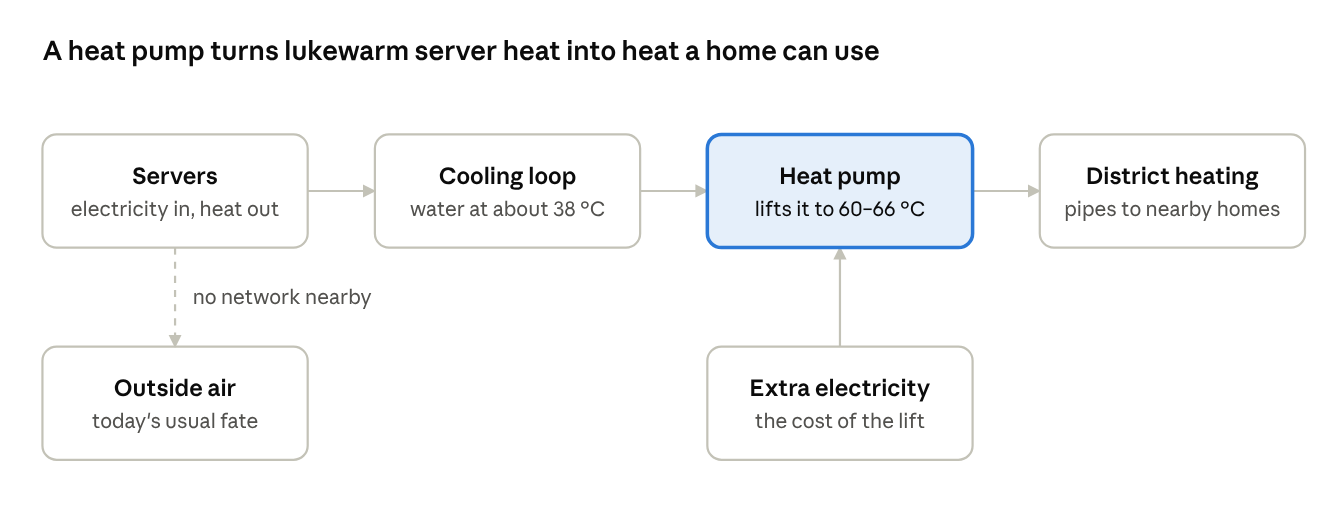
Without a heat network nearby, the heat goes to the outside air; with one, a heat pump bridges the temperature gap.
Imagined futures
1. Planning permission with a pipe attached. Imagine a city that approves a new data center only if it arrives with a heat contract: so many homes, so many schools, so many swimming pools warmed every winter. The data center would stop being an unwelcome neighbor and start being part of the town's infrastructure, like a water tower.
2. Chips that run hotter on purpose. Liquid cooling already lets chips run warmer than air cooling does. Picture servers designed to hand off their heat at the temperature a heating network actually needs. The heat pump's job would shrink and so would its electricity bill.
3. Batteries for heat. The previous article in this series imagined swap stations storing electricity. Now picture giant insulated water tanks or underground caverns soaking up a data center's summer heat and releasing it in January. Server heat would become a seasonal resource, not a daily one.
4. Compute that follows the cold. Some AI jobs, such as training runs, can be moved and scheduled. Imagine a network that sends heavy computing to whichever city is coldest that week, so the heat lands where people need it most. The weather forecast would help decide where your chatbot thinks.
5. The greenhouse next door. Not every customer needs 60 °C. Greenhouses, fish farms and drying plants can use lukewarm heat almost directly. Picture data centers surrounded by year-round tomato farms, with the leftover warmth growing food instead of warming clouds.
Closing the loop
We usually talk about data centers in terms of what they take: electricity, water, land. Heat reuse flips the question to what they could give back.
It will not turn every server farm into a city boiler. Lukewarm heat, long distances and summer surpluses are real limits and the projects in Copenhagen and Milan are still years from full operation. But where the pieces line up, the logic is hard to argue with. The energy has already been paid for. The only question is whether it warms the sky or warms a living room.
The first article in this series showed classical chips keeping quantum computers alive. The second imagined car batteries steadying the grid. This one completes a small circle: the AI machines that worry grid planners might, in the right place, help heat the homes around them.
References
The opening scene and the scenarios in "Imagined futures" are the author's illustration and speculation and are not drawn from any source. The diagram is an original illustration.
- International Energy Agency. Key Questions on Energy and AI, 2026, as reported by W.Media: Data center power demand will double by 2030: IEA. 20 April 2026.
- DatacenterDynamics. atNorth to supply waste heat from DEN01 data center to district heating network in Copenhagen, Denmark. 26 November 2025.
- Baxtel. Equinix to reuse data center heat to warm homes in Milan. 10 July 2026.
- White & Case. Data center requirements under the new German Energy Efficiency Act.
- International District Energy Association. Waste heat from data centres could heat over 3.5 million UK homes. 28 January 2026.
- Data Center Knowledge. How Data Centers Are Transforming Waste Heat Into Efficiency Gains.