A street without parked cars
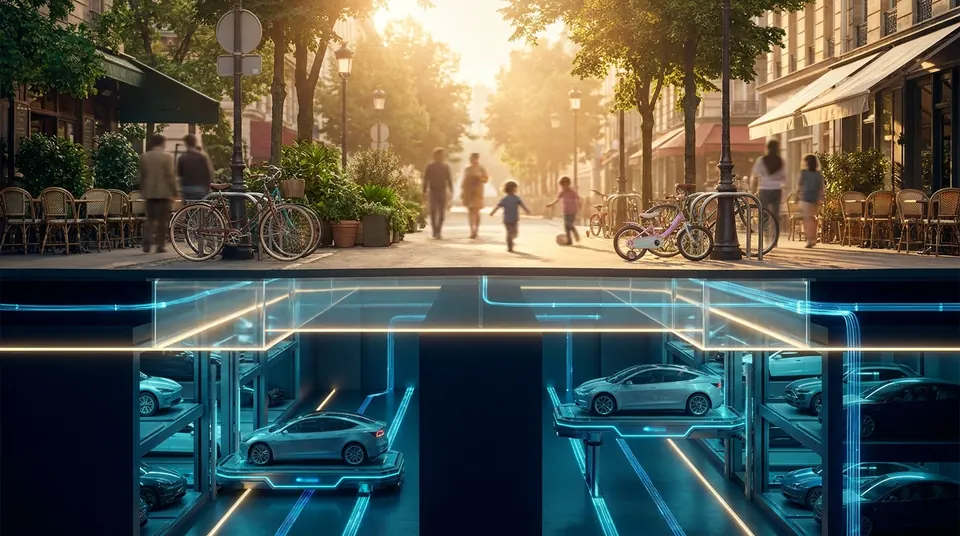
Picture your own street, but with every parked car gone. The curbs are empty. In their place are trees, wider sidewalks, a bike lane, a café terrace a bench in the shade. Cars still come go; they just do not stay.
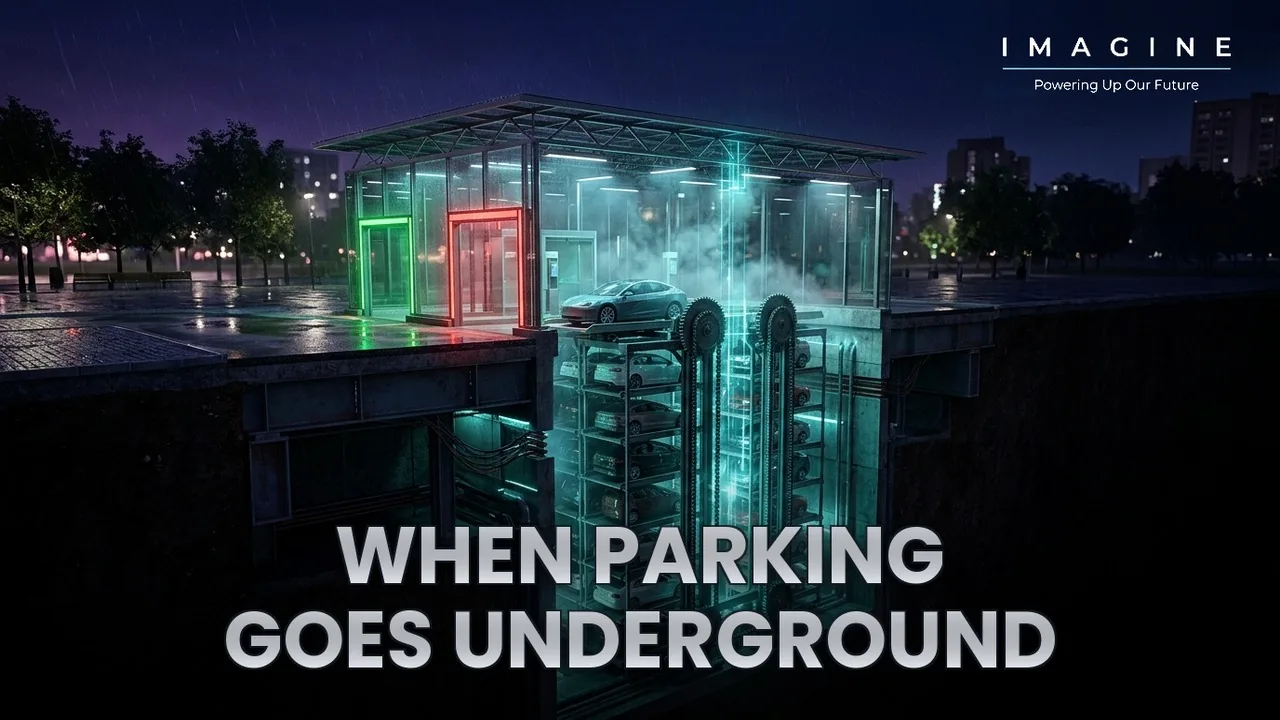
Now picture where the cars went. You pull into a bright bay at street level, step out tap your phone. Behind a glass wall, a low robot slides under your car, lifts it carries it to a lift that descends into the ground. When you come back, your car is waiting, facing the exit.
This is not a concept sketch. Versions of it are opening in cities around the world. Their arrival raises a provocative question: if we stopped storing cars on our streets, what would we build there instead?
A city designed around parked cars
The late UCLA planning professor Donald Shoup, who spent his career studying parking, liked to point out that cars are parked 95% of the time [1]. A car is, in practice, a large object that spends most of its life standing still.
Cities have built themselves around that fact. Curbs are lined with parked cars, surface lots surround shops, multi-story garages fill expensive downtown blocks. Every one of those spaces is land that could have been homes, parks or trees.
Conventional garages are also wasteful by design. They need ramps, driving lanes, turning circles enough headroom for a person to walk drive. Much of the building exists so that humans can steer cars through it.
A robotic garage removes the human from the inside. With no driver to accommodate, cars can be packed tightly, ceilings can be lower ramps disappear. The same number of cars fits into a smaller, often deeper, footprint, the land on top can be given back to the city.
Robots already parking cars
- Shenzhen, underground. A robotic car park beside Shenzhen Children's Park is described as the first two-story underground garage of its kind in Guangdong province the largest in China. Drivers leave their cars at ground level, nine automated guided vehicles, small flat robots that slide under a car carry it, work with nine lifts to store 440 cars. Parking is meant to take under three minutes. It was due to open in June 2026 [2].
- Raleigh, under a plaza. In North Carolina, a 228-space automated garage with robotic lifting bays electric-vehicle charging is being built beneath a new pedestrian plaza in the City Gateway development. It is due by the end of 2026. The city's mayor sees it as a possible future hub for driverless cars, though no such deal exists yet [3].
- West Hollywood, a decade in. A 200-car robotic garage behind West Hollywood's City Hall opened in 2016. Its smaller footprint freed room for a 7,000-square-foot community plaza, the city says retrieval takes a minute or two [4].
The pattern is striking: in each case, the garage shrinks something public appears on top of it, a plaza or a park. The robots are not just parking cars. They are handing land back.
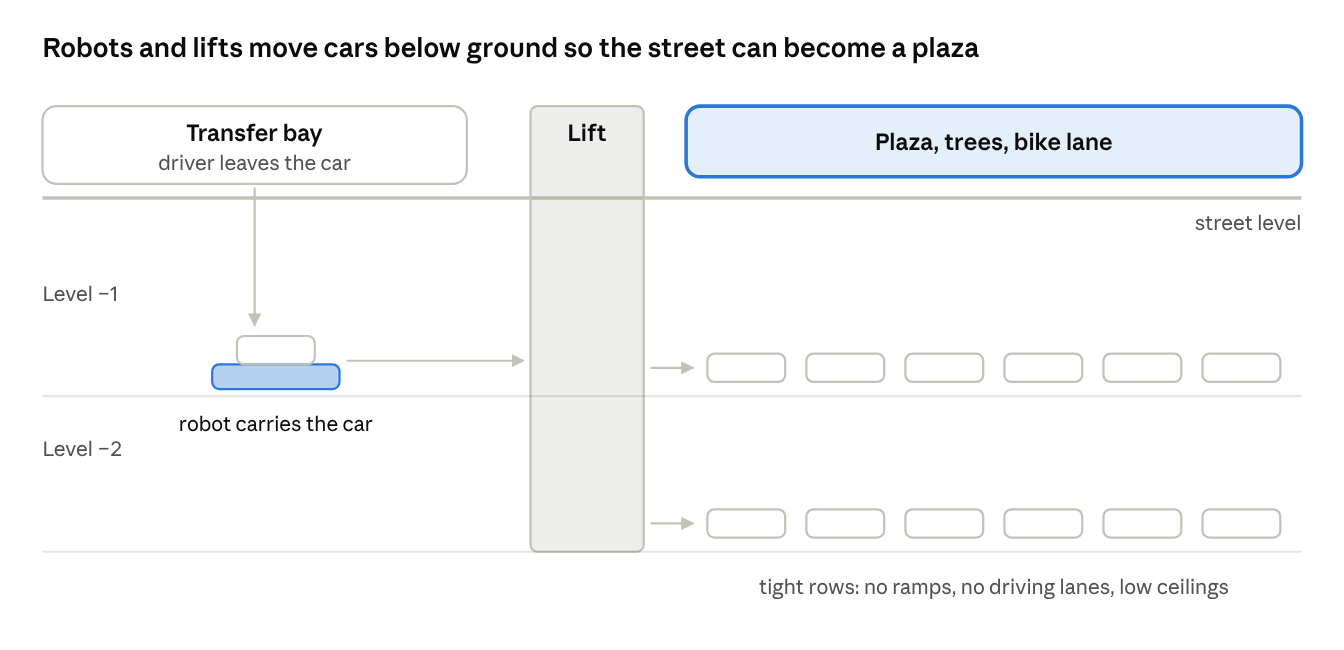
Without people driving inside, the garage needs no ramps or lanes, so it packs more cars into less space frees the surface above.
When the robot says no
A robotic garage has one weakness a concrete ramp does not: if the machine stops, nobody can drive out.
Hoboken, New Jersey, learned this the hard way. In 2010, after a dispute between the city the company behind its 314-space robotic garage over software rights operations, the system shut down cars were stuck inside for several days [5]. The lesson was not about robots failing mechanically. It was about who owns the software, who can fix it what happens when a contract ends. Any city that buys a robotic garage is also buying a long-term relationship with its code.
Throughput is the second test. A robot handling one car at a time is fine on a quiet afternoon. At the end of a concert or a working day, hundreds of drivers may want their cars at once, the queue depends on how many robots lifts the garage has.
Fire is the third, the most serious. In October 2023, a fire in a multi-story car park at London Luton Airport spread from one car to many others caused part of the building to collapse. Investigators found that the car was diesel-powered that the fire most likely began with an electrical fault in its engine bay. Their report suggests a suitable sprinkler system might have changed or slowed its spread [6]. Packing cars tightly in an underground space, where firefighters struggle to reach, makes fire separation, detection suppression central to the design, not optional extras. That matters even more as electric vehicles make up a growing share of what gets parked.
The honest summary: robotic garages save land time, but they trade simple failure for complex failure. Good ones are designed so that a software problem, a power cut or a fire never becomes a disaster.
Imagined futures
1. The deep loop. Imagine going further down: four levels below the street, arranged around a rotating platform loop. Cars glide in on a slowly turning ring that brings each one to a lift, so no robot ever has to search a long aisle. Each level would be sealed into fire-separated sections with its own detection sprinklers, so a problem on one ring stays there. On the surface above, there is nothing but a small glass entrance a park.
2. The garage that charges the grid. Thousands of electric cars parked underground for hours are, in effect, a giant battery. Picture a robotic garage that charges each car when power is cheap clean, coordinates with the energy networks described earlier in this series. The garage could become a quiet partner of the grid.
3. Your car waits for you, not the other way round. Picture a garage that reads your calendar (with your permission) has your car at the exit bay at the moment you arrive, or a robotaxi that slips underground to rest between rides instead of circling the block.
4. Streets designed for people first. Imagine a city that uses robotic garages at the edges of each neighborhood to clear its curbs entirely. Streets become places to walk, cycle, play plant, while deliveries emergency vehicles still pass through. The digital twins from The Planet in the Mirror could help decide which streets to transform first, starting with the hottest.
5. Open software, safer garages. Hoboken showed that a garage is only as reliable as the contract behind its code. Picture open, standardized control software for automated garages, so any qualified engineer can maintain them no city is ever locked out of its own car park.
What the street is for
For a century, cities have quietly answered a question nobody asked out loud: what is a street for? Mostly, it turned out, for storing cars that were not moving.
Robotic garages offer a different answer. Hide the cars underground, stack them tightly, let robots do the shuffling, the surface can go back to people. The early examples in Shenzhen, Raleigh West Hollywood are small. Each shows the same trade, a smaller garage below a plaza above.
The risks are real: software that a city does not control, queues at rush hour fires in confined spaces. Designed well, though, a robotic garage is not just a parking solution. It is a way of giving land back.
In this series we have seen data centers that could warm homes, batteries that could steady the grid robots learning factory work. Here, robots might help return the most valuable land in any city to the people who live there.
References
The opening scene the scenarios in "Imagined futures" are the author's illustration speculation are not drawn from any source; the deep loop concept is the author's own design idea. The diagram is a simplified original illustration.
- UCLA Luskin School of Public Affairs. Shoup explains the hidden high cost of free parking. See also NPR, Remembering urban planning professor Donald Shoup, who changed the way we park, 20 February 2025.
- China Daily Hong Kong. Shenzhen robotic underground car park. 8 April 2026.
- WRAL. City Gateway Raleigh development to build neighborhood automated garage for driverless cars. 13 May 2026.
- Los Angeles Magazine. Years in the making, WeHo now has a robot garage. 12 May 2016.
- Government Technology. Robot garage hijacks cars. 11 August 2010.
- Bedfordshire Fire Rescue Service. London Luton Airport: Car Park 2 incident review. Report published 9 October 2024.
Connected in the Universe
Technology domains
Smart CitiesSmart MobilityRobotics
Companion episode