Automated parking
Mechanical and robotic systems already park cars without a driver in the garage.
Episode 04 · Published on YouTube
What if the best parking space is the one you never see?
Editorial perspectives: Dali · Ethan — The Challenger
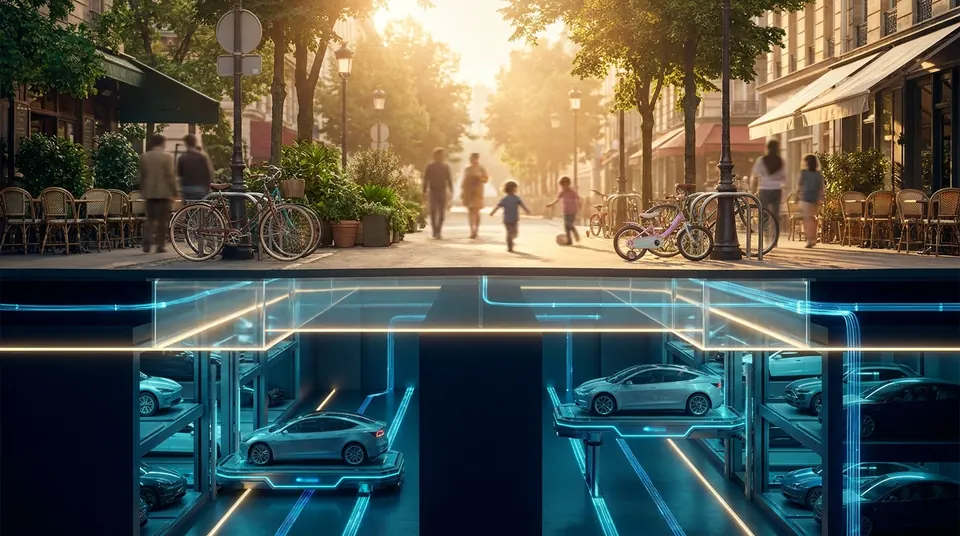
Surface parking takes up some of the most valuable land in our cities. Episode 004 imagines a glass pavilion on a city square: you drive in, step out, and the whole bay sinks below the street. Underground, a loop of ten self-moving bays keeps charging and brings your car back up, already facing the exit.
Every evening, curbs are lined with parked cars while drivers circle in search of a space. What if the cars could simply disappear below the street, and the space they leave behind went back to the people who live there?
Dali connects the systems. Ethan tests the trade-offs. These are the editorial perspectives through which we explore this question.
Published on YouTube · EnterImagine
The player connects to YouTube/Google only when you load it. Playback may use cookies or other storage. You can also watch directly on YouTube.
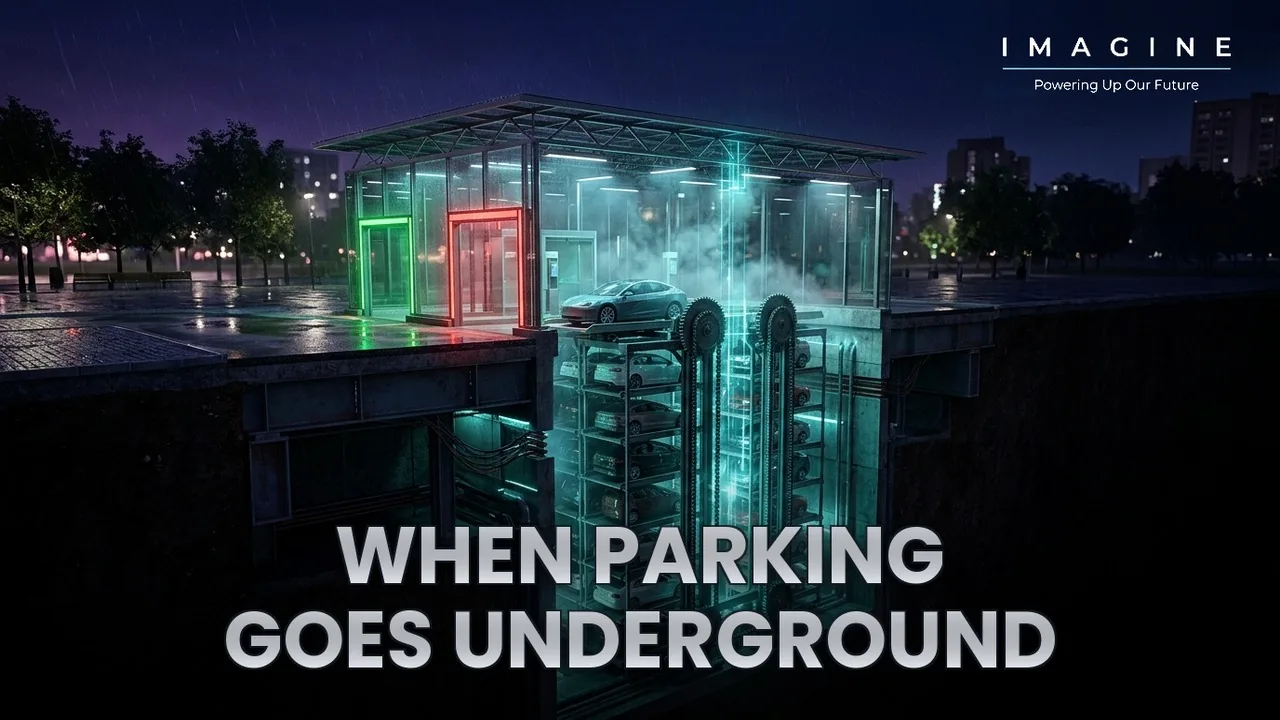
A glass pavilion stands on a city square. You drive in on one side, step out through a sliding door, and the whole bay sinks below the street, car and all. The next morning your car rises in the other bay, already facing the exit.
Underground, a loop of ten bays turns like a vertical carousel. Because the bays hang in a loop, they balance one another, and three motors are enough to drive it. Charging continues while the bays rotate.
Green for empty, red for occupied, managed from one control room. Above ground, the squares and curbs once filled with parked cars could be given back to trees, walkways and people.
Enter the pavilion on one side and leave the car on its bay.
The bay goes below the street and joins a loop that keeps cars charging as it turns.
Your car returns on the other side, already facing the exit.
Potential applications
Different capabilities, different conditions. The whole system has to work.
Mechanical and robotic systems already park cars without a driver in the garage.
Entry and exit by license plate, as many garages already do today.
Electric cars charge while they wait below the street.
Curbs and squares reclaimed for trees, walkways and terraces.
What exists today
Automated and mechanical parking systems already operate in cities today, and license plate recognition is standard at many parking garages.
What we can imagine
Could a drive-in, walk-away pavilion with a self-moving underground loop free city squares for people while cars keep charging below?
Ambition, tested

“But what are we missing?”
The self-moving loop pavilion, its charging rail and the space figures shown are an IMAGINE concept, not an existing product. Digging costs, groundwater, fire safety and rescue access are real challenges that would need to be solved.
Production disclosure
As disclosed with the published video, this episode uses AI-generated and digitally created illustrations. The pavilion, the underground loop and the city scenes are conceptual visuals, not footage of a real installation. The self-moving loop pavilion, its charging rail and the space figures shown are an IMAGINE concept, not an existing product. Future possibilities are scenarios, not guaranteed outcomes.
Current tools. Experimental workflows. Imagined outcomes.
Operating in cities today; designs and capacity vary.
Standard at many garages; privacy rules differ by country.
An IMAGINE concept, not an existing product; digging, groundwater, fire safety and rescue access are real challenges.
Scientific Universe
Keep exploring
What If?