
Fifty thousand drops a second
In a vacuum chamber in San Diego, a nozzle spits out droplets of molten tin, each thinner than a human hair. Fifty thousand of them fly out every second, faster than 241 kilometers per hour [1].
As each droplet passes, a powerful carbon-dioxide laser hits it with two pulses. The tin bursts into a glowing plasma that gives off extreme ultraviolet (EUV) light at a wavelength of 13.5 nanometers, far shorter than anything the eye can see [1].
That light is gathered by mirrors and sent into a lithography scanner, a machine that prints the finest patterns on the world's most advanced computer chips. The mirrors come from a single supplier in Germany. The scanners come from a single company in the Netherlands, ASML [1][2][3].
The chips printed this way end up in the servers that train AI models and in the processors of new laptops [3]. A huge share of the digital world passes through one kind of light, made one way, by one supply chain.
Network engineers have a name for a design where everything funnels through one thin layer: a "narrow waist." Modern technology has several of them. Some are machines. Others are a gas, a metal or a quarry.
This article follows those narrow points across every domain IMAGINE covers, because together they explain why a change in one place can echo through all the others.
Where the road gets narrow
Picture a mountain pass. The valleys on either side can be wide and busy, but every truck has to squeeze through the same few hundred meters of road. Close the pass and traffic stops in places that never seemed to depend on it.
A technology chokepoint works the same way. It is a step in a supply chain where one company, one region or one material handles most of the world's flow and where there is no quick substitute.
These chokepoints are not new. What makes them timely now is a cluster of dates and events in 2026.
In late 2025, China paused a set of export restrictions on rare earths, battery materials and related technologies until November 10, 2026. It separately paused a ban on exports of gallium, germanium and antimony to the United States until November 27, 2026. Other controls stayed in place, including licensing for seven medium and heavy rare earths [4]. On September 28, 2026, after a new round of US–China talks, China's commerce ministry said the broader trade arrangement behind those pauses would be extended to January 10, 2027, with more talks planned before year-end [5]. Governments, analysts and companies are watching how that is put into practice.
The International Energy Agency (IEA) added a wider view in July. In its Global Critical Minerals Outlook 2026, it estimated that about $6.5 trillion of yearly production outside China could be exposed if the October 2025 controls were fully applied [6].
And in March, a very different shock reminded everyone that chokepoints are not only about trade policy. Production at Qatar's Ras Laffan complex, which supplies roughly a third of the world's helium, was halted during the regional conflict and chipmakers rely on helium in several manufacturing steps [7].
The question this raises is simple: where exactly are the narrow points and which technologies sit behind each one?
Seven narrow points, domain by domain
Here are the chokepoints that show up most clearly in official data and recent reporting and the IMAGINE domains that depend on them.
- EUV light and optics (AI & Data). ASML's 2025 annual report names Zeiss as its sole, exclusive supplier of EUV optics and says Zeiss's capacity limits how many scanners ASML can build. ASML expects to ship roughly 65 standard EUV systems in 2026 and is planning about 30% more for 2027 [2]. In July, ASML announced that Intel had begun high-volume shipments of processors made partly with its newest, higher-resolution "High-NA" EUV machines, an industry first [3].
- Advanced packaging (AI & Data). Today's AI chips are assemblies: processors and memory stacked side by side on a shared base. Capacity for one leading technique, TSMC's CoWoS, has been tight; Taiwanese reporting cited investor estimates that the gap between supply and demand was narrowing in 2026 [8]. In June, TSMC and Amkor signed a 10-year deal for advanced packaging and testing in Arizona [9].
- Gallium (Energy, Smart Mobility). The US Geological Survey estimates that China produced about 99% of the world's primary low-purity gallium in 2025 and that the United States imports 100% of what it uses [10]. Gallium nitride chips handle power efficiently in data centers, electric vehicles and renewable energy systems. According to the Center for Strategic and International Studies (CSIS), China's exports of unwrought gallium fell 94% in 2025 compared with 2024 [11].
- High-purity quartz (AI & Data, Energy). Silicon for chips and solar cells is melted in quartz crucibles and BloombergNEF estimates that more than 80% of the ultra-pure quartz used for such crucibles comes from Spruce Pine, North Carolina. When Hurricane Helene approached in September 2024, both of the town's producers halted mining [12].
- Germanium (Space). Germanium wafers are the base for the high-efficiency solar cells that power many satellites and germanium also goes into fiber optics and infrared lenses [13][14].
- Helium (Quantum, Biotech). Beyond chipmaking, helium cools MRI scanners, which account for about 15% of US helium use, with no substitute for cooling that cold [15]. Superconducting quantum computers need helium-3 and helium-4 to reach temperatures about 10 to 20 thousandths of a degree above absolute zero [16].
- Rare-earth magnets (Robotics). Strong neodymium magnets, often doped with dysprosium or terbium, power the compact electric motors in robot joints, according to industry reporting [17]. The IEA reports that the top refiner's share of rare-earth processing fell from over 90% in 2023 to 85% in 2025 [6].
Seen together, the list explains why one announcement about minerals can matter to a data center, a satellite operator and a hospital at the same time.
The map of the narrow points
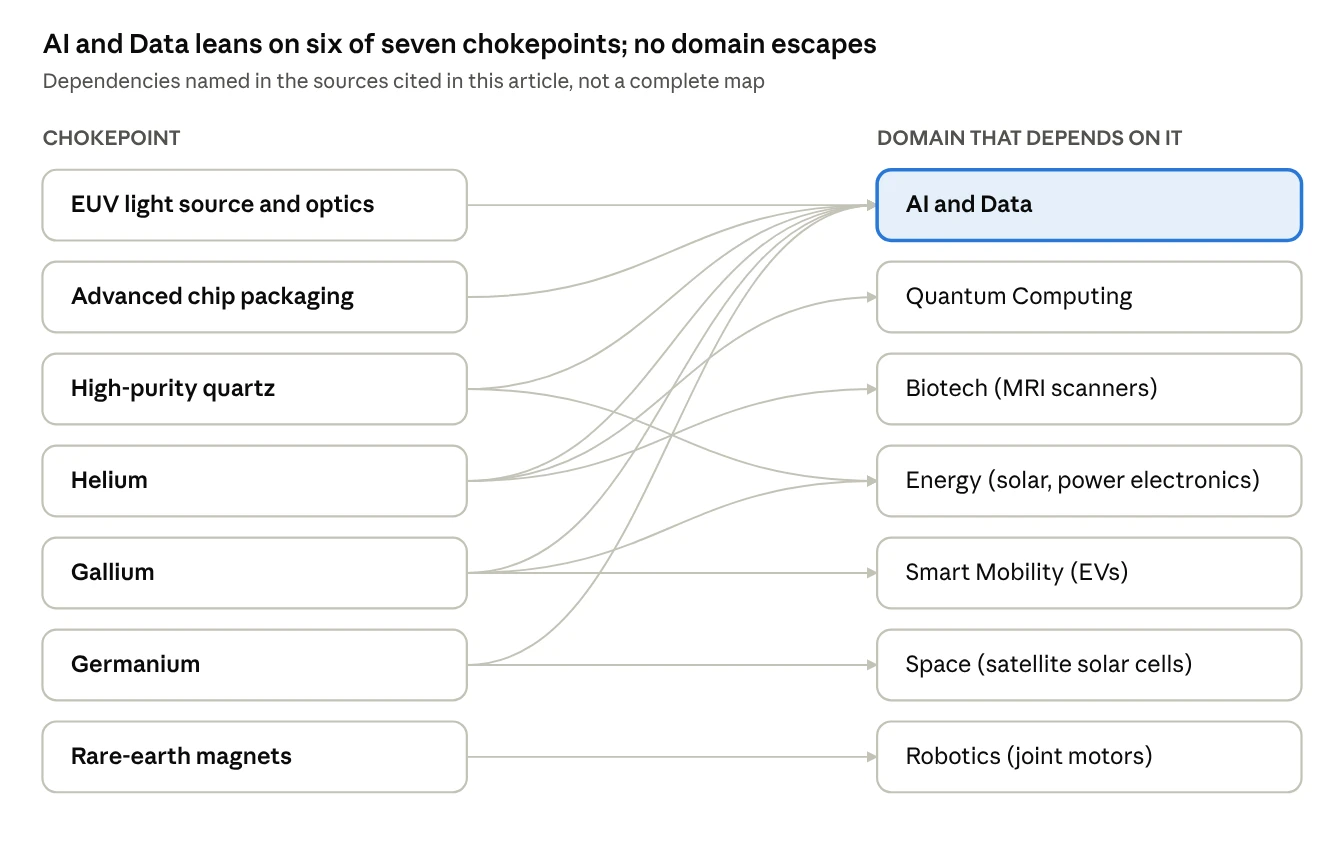
Read from left to right: every domain IMAGINE covers depends on at least one of these narrow points and AI and Data depends on almost all of them, which is why a single disruption rarely stays in one industry [2][6][7][10][11][12][13][15][16][17].
The same thing that makes it strong
It is easy to treat chokepoints as mistakes that someone forgot to fix. The twist is that many of them exist for the same reason the technology works so well.
The EUV optics are a good example. The projection optics for the newest machines contain more than 40,000 parts and a single mirror can weigh several hundred kilograms [2]. Very few organizations on Earth can build them. That deep specialization is what made today's chips possible. It is also why ASML's output is capped by one supplier's factory [2].
Think of a world-class orchestra with only one oboist who can play a certain passage. The music is extraordinary. But if the oboist catches a cold, the concert is in trouble.
Building a second oboist takes years. Zeiss staff moved into the first new building of its expansion in July 2026, four years after breaking ground [2]. In Japan, the chipmaker Rapidus is preparing 2-nanometer production for the second half of fiscal 2027, backed by about ¥2.9 trillion in planned government support and as of July it had not announced a committed high-volume customer [18]. New gallium supply outside China is not expected to reach full capacity before mid-2027, according to CSIS [11].
The numbers themselves also deserve care. Shares depend on definitions: the USGS gallium figure covers primary low-purity metal, not every refined grade [10] and the Spruce Pine share is an analyst estimate [12]. A single headline percentage rarely tells the whole story.
Finally, chokepoints can loosen and warnings help. The IEA's figures show the leading rare-earth refiner's share already slipping and projects in the pipeline could bring it to 70% by 2035 [6]. In 2022, war halted Ukrainian producers that had supplied more than half of the world's neon, a gas that powers chipmaking lasers, according to one industry analyst. Chipmakers were partly cushioned: after 2014, they had added suppliers elsewhere and typically held months of stock [19].
In other words, the goal is not to eliminate every narrow point. It is to know where they are and to keep a spare path open.
Imagined futures
A weather map for supply chains. Forecasters already turn millions of readings into a storm warning. A similar public map could combine shipping data, factory notices and mineral statistics to show where the narrow points are tightening, giving hospitals, carmakers and data centers days or weeks of warning instead of surprises.
Mines inside our cities. Today, gallium is recycled mostly from factory offcuts rather than from old devices [10][11]. Cheaper sorting robots and better chemistry could one day pull gallium, germanium and rare earths from discarded electronics at scale, turning a city's scrap stream into a modest, local source.
Cold without the gas. Many modern quantum refrigerators already need far less liquid helium than older designs [16]. Pushed further, sealed systems that recycle every atom could let MRI scanners and quantum labs ride out a helium shock with little more than a maintenance check.
Designs with a plan B. Engineers could routinely design motors, power chips and sensors with an approved second recipe, one that uses a different material if the first becomes scarce. Like a spare tire, it would rarely be used, but its existence would change how a shortage feels.
Help from orbit. If space-grown crystals ever deliver the purity their developers hope for, as described in The Factory That Falls From the Sky, a small amount of seed material made in orbit could add one more door to the chip supply chain.
Seeing the waist
Return to that vacuum chamber in San Diego, where tin droplets fly past a laser fifty thousand times a second [1]. It is one of the most impressive machines ever built. It is also a reminder that progress tends to concentrate.
The deepest skills, the purest materials and the most advanced factories end up in a few places, because that is where the know-how lives. Every domain in this series, from robots to satellites to quantum computers, inherits both the power and the fragility of those places.
The takeaway is not alarm. It is literacy. When a deadline like November 10 comes and goes, or a gas plant on the other side of the world shuts down, a reader who knows the map can see which technologies will feel it and which will not.
The narrow waist sits quietly behind earlier stories in this series too. The data centers in The Server Farm That Warms Your Living Room and the swap-station batteries in Batteries in Waiting both run on chips and materials that pass through a handful of doors.
Next in the series: from the narrow doors of the supply chain to the oldest storage medium on Earth, in “The Archive That Fits in a Pill.”
References
All sources were opened and checked on October 27, 2026. Figures from ASML, Zeiss, TSMC and other companies are company-reported. The status of the November 2026 export-control dates may change quickly.
- ASML, "San Diego" (location page), accessed October 27, 2026.
- Tom's Hardware, "Zeiss expands German site that caps ASML's EUV scanner output", July 26, 2026.
- ASML, "High NA EUV reaches new readiness milestone with first high-volume Logic product", July 15, 2026.
- Pillsbury Winthrop Shaw Pittman, "China Suspends Export Controls on Certain Critical Minerals and Related Items", November 13, 2025.
- Geopolitechs, "New Details on U.S.-China Trade Talks", September 28, 2026.
- International Energy Agency, "Supply concentration, export restrictions and declining investment put critical mineral security at risk" (Global Critical Minerals Outlook 2026), July 16, 2026.
- Tom's Hardware, "The global helium shortage is a direct threat to the chipmaking supply chain", March 2026.
- TrendForce, "TSMC CoWoS Supply-Demand Gap Reportedly Seen Narrowing from 20% to 10% by End-2026 as Capacity Expands", June 15, 2026.
- Focus Taiwan (CNA), "TSMC, Amkor sign 10-year deal to boost advanced chip packaging in U.S.", June 18, 2026.
- US Geological Survey, Mineral Commodity Summaries 2026: Gallium (PDF), 2026.
- Center for Strategic and International Studies, "The U.S.-China Trade Truce Has Not Solved the Gallium Problem", May 11, 2026.
- Grist, "The solar supply chain runs through this flooded North Carolina town", October 2024.
- US Geological Survey, Mineral Commodity Summaries 2026: Germanium (PDF), 2026.
- Journal of Space Commerce (Exterra), "The elements China controls", July 9, 2026.
- US Geological Survey, Mineral Commodity Summaries 2026: Helium (PDF), 2026.
- Verdict, "US-Iran war: will helium shortages risk major disruption to quantum computing companies?", March 10, 2026.
- THG News (The Humanoid Group), "China's Rare-Earth Export Control Pause Nears November 10 Expiry", September 10, 2026, updated October 7, 2026 (trade press, citing Fastmarkets).
- Tom's Hardware, "Rapidus fab roadmap examined", July 8, 2026.
- CNBC, "Chip industry under threat with neon production set to fall off a cliff following Russia's invasion of Ukraine", March 25, 2022.