A shelf with no plug
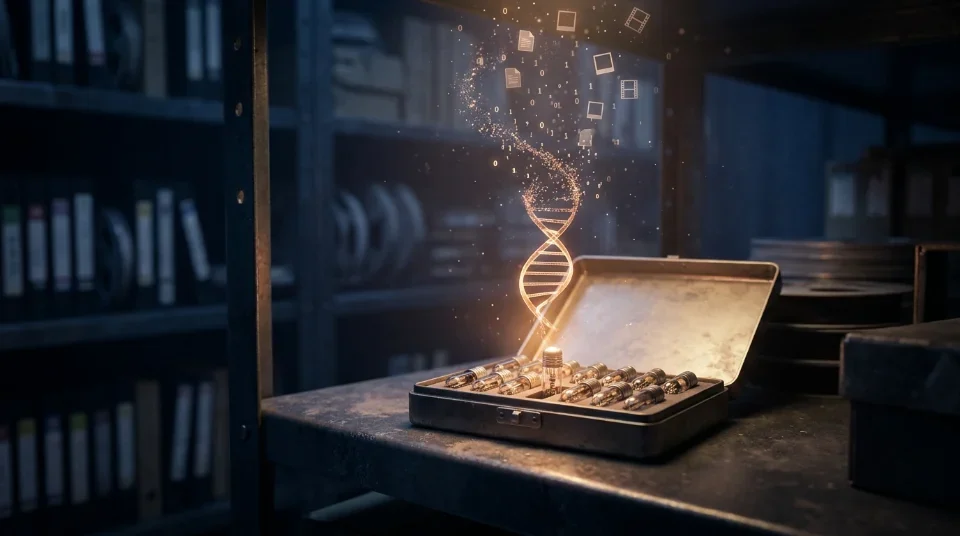
Picture a box about the size of a carton of milk. Inside sit rows of capsules, each no bigger than a pill. There is no fan, no blinking light and no power cable. According to the company that built it, that box can hold 60 petabytes, roughly 660,000 movies in 4K [4].
The capsules do not contain magnetic tape or silicon. They contain dried strands of synthetic DNA, the molecule that carries the instructions for every living cell. Atlas Data Storage, a spinout of the DNA maker Twist Bioscience, announced the product, called Eon 100, in December 2025. The company says the data inside can last for millennia without ever being copied to fresh media [4].
It sounds like the perfect answer to the flood of data that artificial intelligence is producing.
There is one catch and it is a large one. Writing data into DNA still costs millions of times more than writing it to tape [3].
The flood and the cold shelf
The analyst firm IDC forecasts that the world's "datasphere," all the data created, captured and copied in a year, will reach about 394 zettabytes by 2028, nearly ten times the 2018 level [1]. A zettabyte is a billion terabytes. By then, IDC expects the world to generate about 12.5 petabytes every second [1].
Most of that data is used once and then put away: old training sets, medical scans, film masters, sensor logs, legal records. Archivists call it cold data. Today, the cheapest place to keep it is magnetic tape and tape is booming. Shipments of LTO tape capacity rose 57% year on year in the first quarter of 2026 and the industry points to AI datasets and archives as the reason [2]. One LTO-10 cartridge holds 40 terabytes before compression [2].
But tape and hard drives age. Archives must be copied onto new media every five to ten years and the machines that hold them need power and cooling the whole time. Over 25 years, one industry analysis notes, those migrations and running costs can exceed the price of the media itself [3].
DNA offers a different bargain. Once written and dried, it needs no electricity to keep [3]. It is extraordinarily dense. And as long as biology runs on DNA, someone will build machines that can read it. The question is whether that promise survives contact with a price list.
From lab bench to service desk
The past twelve months moved DNA storage from pure research toward its first products, factories and standards.
- A rack-ready product. Atlas says Eon 100 holds 60 PB in about 60 cubic inches, about 1,000 times denser than LTO-10 tape, with capsules stable up to 40 °C [4]. These are company figures. Atlas has not published price, write speed or read speed and reviewers note that its speeds are far below tape or flash [4][14].
- A chip foundry joins in. In March 2026, the Belgian research center imec took an equity stake in Atlas and agreed to co-manufacture a chip, made on 300 mm silicon wafers, that controls millions of tiny DNA-writing sites at once [5]. Atlas itself says writing throughput must still grow "by several orders of magnitude" [5].
- Enzymes on silicon. In June 2026, a Harvard-led team reported in Nature Electronics a chip that grew 64 different DNA strands side by side using enzymes in water, instead of the harsh solvents of conventional chemistry [6]. Earlier enzyme methods managed about a dozen strands at a time. The demo stored a 169-byte message, a reminder of how early this still is [6].
- The first paid service. On October 15, 2026, the French company Biomemory opened early access to DNA Shield. Customers encrypt their data, Biomemory encodes it into DNA and the molecules sit offline in managed custody until someone deliberately triggers a recovery [7]. Biomemory bought the assets of the Boston pioneer Catalog in March 2026 and says broader storage products will follow from 2029 [7][8].
- Shared rules. The DNA Data Storage Alliance, now part of the storage industry body SNIA, has published early specifications, including a method for testing how stable stored DNA stays over time [13].
Notice who DNA Shield is aimed at: holders of encryption keys, industrial secrets and "golden records" [7]. Tiny volumes of very precious data. That choice explains the next section.
Cheap to keep, costly to carve
Storing data in DNA is a little like carving it into stone. Once carved, it lasts and costs almost nothing to keep. The carving is the expensive part.
In August 2026, researchers at Imperial College London and the University of Marburg posted an economic analysis of DNA storage as a preprint, which has not yet been peer reviewed [9]. They estimate that writing DNA cost about $19,588 per megabyte in 2025, while reading it cost about 22 cents. Synthesis made up more than 99.9% of the total [9]. On their numbers, DNA is about ten billion times costlier to write than tape. Even if synthesis costs fall 48–80% a year, they place write-cost parity with tape somewhere between 2060 and 2090 [9].
Other estimates are kinder but still sobering. A January 2026 industry analysis put writing at about $100 per megabyte, which is more than 2.5 million times the cost of tape [3]. The two figures differ by roughly 200 times. That gap says as much as the numbers do: the companies selling DNA storage do not publish their costs, so outsiders must reconstruct them.
Speed is the second wall. Reading DNA means sequencing it, which takes hours or days rather than milliseconds [3]. A 2025 study in Science Advances that built an indexed "DNA cassette tape" needed about 2.5 hours to recover its files [10].
Even durability, the strongest selling point, needs care. Lab work supports very long lifetimes: one team estimated that DNA protected inside a metal-organic framework, a kind of molecular cage, could last about 20,000 years at 0 °C [11]. But storage analysts point out that claims of millennia for commercial products remain projections rather than test results [12].
So the honest picture is this. DNA storage works physically. Its economics do not yet work for bulk data. That is why the first customers look like vaults, not warehouses.
How a file becomes a molecule
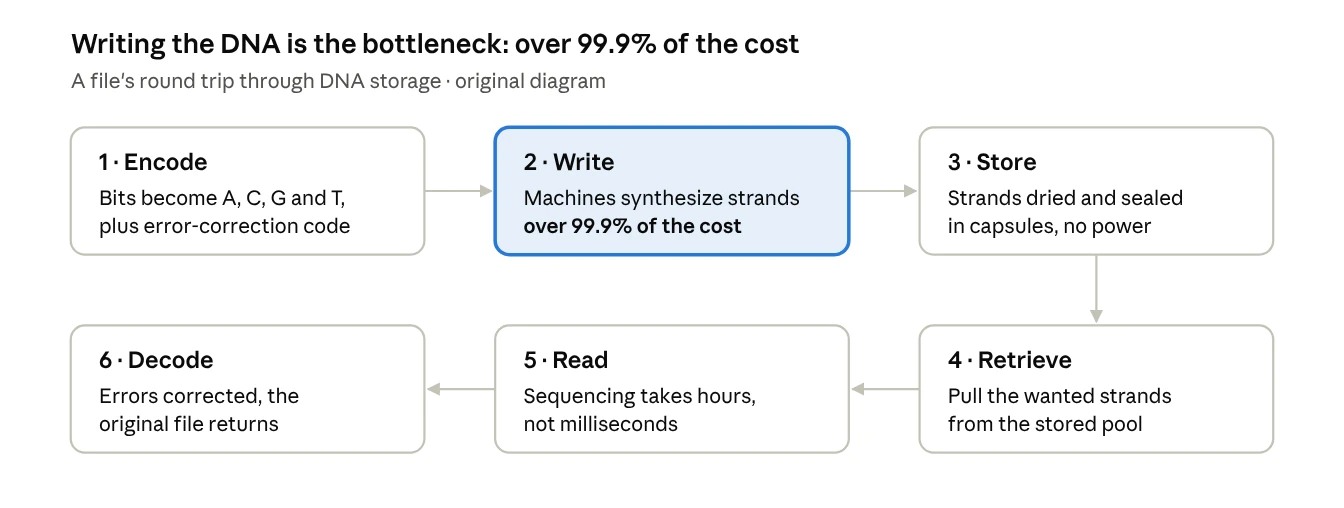
Every step on this loop already works in a lab. The step that decides whether DNA can compete with tape is the second one, writing, which makes up more than 99.9% of the cost in one recent analysis [9].
Imagined futures
The AI model's birth certificate. Large AI models learn from datasets that are later edited, replaced or deleted. A lab could one day write a compact fingerprint of each training set, its index and checksums rather than the data itself, into DNA. Auditors decades later could then check exactly what a model learned from.
A seed vault for culture. Seed banks keep crop varieties safe in cold vaults inside mountains. A national library could keep a DNA "seed" of its digital collection the same way: written once, stored dry, untouched by power cuts or format changes and readable by anyone with a sequencer.
The printer beside the server. If chips like the imec–Atlas design scale up, a DNA writer could become one more appliance in the data center, next to the tape library. Cold data would sink through a hierarchy: flash, then disk, then tape, then molecules.
Keys in a test tube. DNA Shield hints at a security idea: data that cannot be hacked over a network because it is not on one. A hospital or a bank could keep its master encryption keys as molecules in a safe, recoverable only through a deliberate lab process.
A library that rides along. Long space missions must carry their own archives. A dry capsule of DNA weighs almost nothing and needs no power, which could make it an appealing backup for a lunar base, provided its tolerance to space radiation holds up in testing.
The pill on the shelf
Go back to the box of pills. Today it is less a replacement for tape than a signpost. Biology and the chip industry have started to work on the same problem and the first products, foundry deals and services are real.
The physics is settled: DNA is dense, stable and needs no power to keep. The open question is cost and the gap is measured in millions of times, possibly billions. A chip breakthrough could narrow it faster than the forecasts suggest, or it could close only over decades.
Either way, the first users will be those who value permanence over price. That makes DNA the far end of a story this series has followed before. In The Server Farm That Warms Your Living Room and Can You Cool a Data Center in Space?, the problem was too much heat from data that is always on. Here, the data is so cold that it needs no energy at all.
Next in the series: the extreme cold that quantum computers depend on and why a helium shortage in 2026 put it at risk.
References
All sources were opened and checked on October 28, 2026. Company figures are flagged as company-reported in the text.
- IDC. Global DataSphere latest trend forecast (Chinese-language summary). October 2024.
- StorageReview. LTO tape shipments up 57% in Q1 2026 as AI and archive demand accelerate. September 2, 2026.
- Blocks & Files. DNA data storage: When the physics work but the economics don't. January 16, 2026.
- Tom's Hardware via Yahoo Tech. World's first scalable DNA data storage offering announced. December 6, 2025.
- StorageNewsletter (imec and Atlas Data Storage release). Next-generation, permanent DNA-based data storage for the AI age. March 10, 2026.
- Harvard John A. Paulson School of Engineering and Applied Sciences. Making DNA on a semiconductor chip. June 17, 2026.
- Biomemory via PR Newswire (Yahoo Finance). Biomemory launches DNA Shield, the first commercial product built on its molecular IT platform. October 15, 2026.
- DatacenterDynamics. DNA data storage startup Biomemory acquires Catalog Technologies. March 2026.
- arXiv (Imperial College London and University of Marburg). An economic analysis of DNA-based data storage systems. Preprint, August 26, 2026.
- The Register. "Boffins invent DNA tape that could pack 375 petabytes into an LTO cart". September 12, 2025.
- Live Science. New DNA cassette tape can store up to 1.5 million times more data than a smartphone. December 12, 2025.
- Forbes. DNA storage evolves with Atlas/imec collaboration and Biomemory acquisition. March 8, 2026.
- Library of Congress, Designing Storage Architectures meeting. Atlas Data Storage presentation (slides). March 10, 2026.
- Hardware Busters. Atlas launches first scalable DNA data storage. January 4, 2026.