Colder than deep space, on purpose
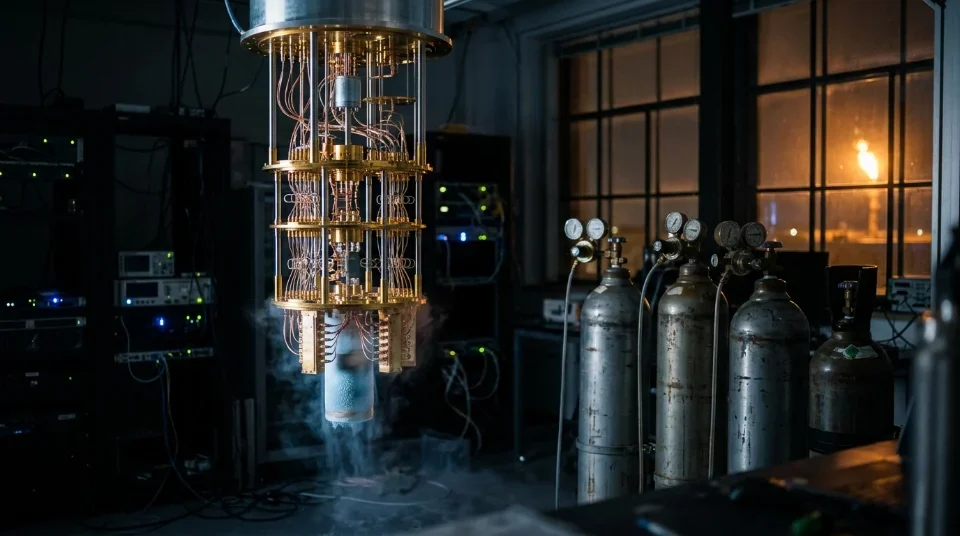
In Poughkeepsie, New York, IBM runs a pair of box-shaped modules that together stand more than eight feet tall and eight feet wide [1]. Inside, nested metal shields step down from room temperature like the layers of an onion, each one colder than the last. It takes under five days just to reach 4 kelvin. At the bottom, the system settles at about 15 thousandths of a degree above absolute zero, or 15 millikelvin [1].
That is far colder than the space between the stars. It has to be. IBM's qubits, the basic units of its quantum computers, are tiny superconducting circuits that only behave in a quantum way when almost every trace of heat is gone. IBM expects its Starling machine, planned for 2029, to need about a dozen of these linked modules [1].
The deepest stage of that cold comes from a machine called a dilution refrigerator. Its working fluid is helium.
Here is the surprise. Most of the helium that makes this cold possible comes out of natural gas fields. And in March 2026, about a third of the world's supply stopped flowing.
A gas nobody can make
Helium is the second most common element in the universe, yet on Earth it is scarce. It forms slowly from radioactive decay underground, gathers in some natural gas deposits and drifts off into space once released. In 2025 the world produced about 190 million cubic meters of it [2]. The United States was the largest producer. Qatar made about 63 million cubic meters, Russia 18 million and Algeria 11 million [2]. Qatar's helium is separated at the same giant plants that turn its natural gas into liquefied natural gas, or LNG [3].
Who uses it? According to the US Geological Survey, lab and analytical work took 22% of US consumption in 2025, semiconductors, fiber optics and controlled atmospheres 17% and MRI scanners 15% [2]. Quantum computing does not even get its own slice. Its demand is small in volume, but nothing else can do the job.
The rarer variety matters even more. A dilution refrigerator runs on a mixture of ordinary helium-4 and helium-3, a lighter isotope with one fewer neutron. Think of it as a cocktail: when the two kinds of helium separate at the coldest stage, helium-3 atoms crossing from one layer to the other soak up heat, a little like sweat evaporating from skin.
Helium-3 barely exists in natural gas. Most of the world's supply comes from the slow radioactive decay of tritium held in the US nuclear stockpile [8]. Policy analysts estimate that a single dilution refrigerator holds 10 to 100 liters of it and that the isotope can account for up to a quarter of the fridge's cost [9].
The year the cold got scarce
Several things happened in 2026 that turned a niche supply chain into front-page news.
- The shock. In early March 2026, during the conflict involving Iran, QatarEnergy halted production at its Ras Laffan LNG complex and declared force majeure [3]. On March 18–19, Iranian missile strikes damaged two of its liquefaction trains, about 17% of Qatar's LNG capacity. QatarEnergy said repairs could take up to five years and helium from those trains stops until then [4].
- The squeeze. By October, with shipping through the Strait of Hormuz disrupted, roughly one-third of global helium supply was cut off, CBS News reported [5]. Estimates of the spot-price increase range from a doubling to a tripling [3][5]. A University of Chicago lab that runs nuclear magnetic resonance (NMR) magnets saw its deliveries cut to half of last year's [5].
- A policy response. On October 23, 2026, the US Department of Energy designated helium a "critical material," citing semiconductor manufacturing and the lack of practical substitutes [6]. Helium had been dropped from a federal list of critical minerals in 2022 [7].
- New sources of helium-3. The startup Interlune reports that in July 2026 it purified helium-3 to 99% from ordinary US helium using cryogenic distillation. It says the method, rolled out across US plants, could yield up to 2.5 kilograms a year [10]. Interlune also holds a DOE agreement to deliver 3 liters of helium-3 gathered from the Moon by April 2029 [11] and the fridge maker Bluefors has agreed to buy up to 10,000 liters a year from 2028 to 2037 [12].
- Machines that sip instead of gulp. Siemens Healthineers' MAGNETOM Flow MRI, cleared by the FDA in January 2026, seals in 0.7 liters of liquid helium for the scanner's life, the company says, versus more than 1,000 liters for conventional scanners [14]. Philips reports more than 1,500 BlueSeal scanners installed, each sealed with about 7 liters [15]. Labs are recapturing what boils off: the University of Edinburgh's recovery system cut its helium purchases by 89% [16].
The cold has an energy bill
The non-obvious part is that quantum computing's helium problem is really two problems and the bigger one may not be the gas itself.
The first is scale. A team at Oak Ridge National Laboratory estimates that a fault-tolerant superconducting quantum computer could need roughly 1 to 10 watts per qubit for cooling and control. At a million qubits, that means tens to hundreds of megawatts at a single site [17]. The same team warns that US helium-3 output in 2025 might supply only a small number of such large machines [17]. These are projections, not measurements. Still, they turn a laboratory curiosity into an energy question much like the one facing AI data centers.
The second is that alternatives exist, with trade-offs. Not every quantum computer needs millikelvin cold. Trapped-ion, neutral-atom and photonic machines avoid the dilution stage [13]. Helium-3-free magnetic refrigerators exist as well. Kiutra's demagnetization coolers run continuously below 30 millikelvin, but with only about 3 microwatts of cooling power at 50 millikelvin, compared with more than 30 microwatts at 20 millikelvin for a large dilution fridge [13]. Cooling power is the budget for heat leaking in through wires and electronics, so for now these suit smaller experiments rather than big processors.
Then there is the Moon. Lunar helium-3 is real on paper, but extraction has not been demonstrated beyond early excavation work. Interlune targets an extraction demo in 2027 and a pilot plant in 2029, while independent analysts do not expect commercial volumes before the early 2030s [13].
So the honest answer is mixed. The 2026 shock hit labs and hospitals first. Quantum computing's exposure is narrower, but harder to escape: today, nothing replaces helium-3 at the scale large superconducting machines will need.
Where the cold comes from
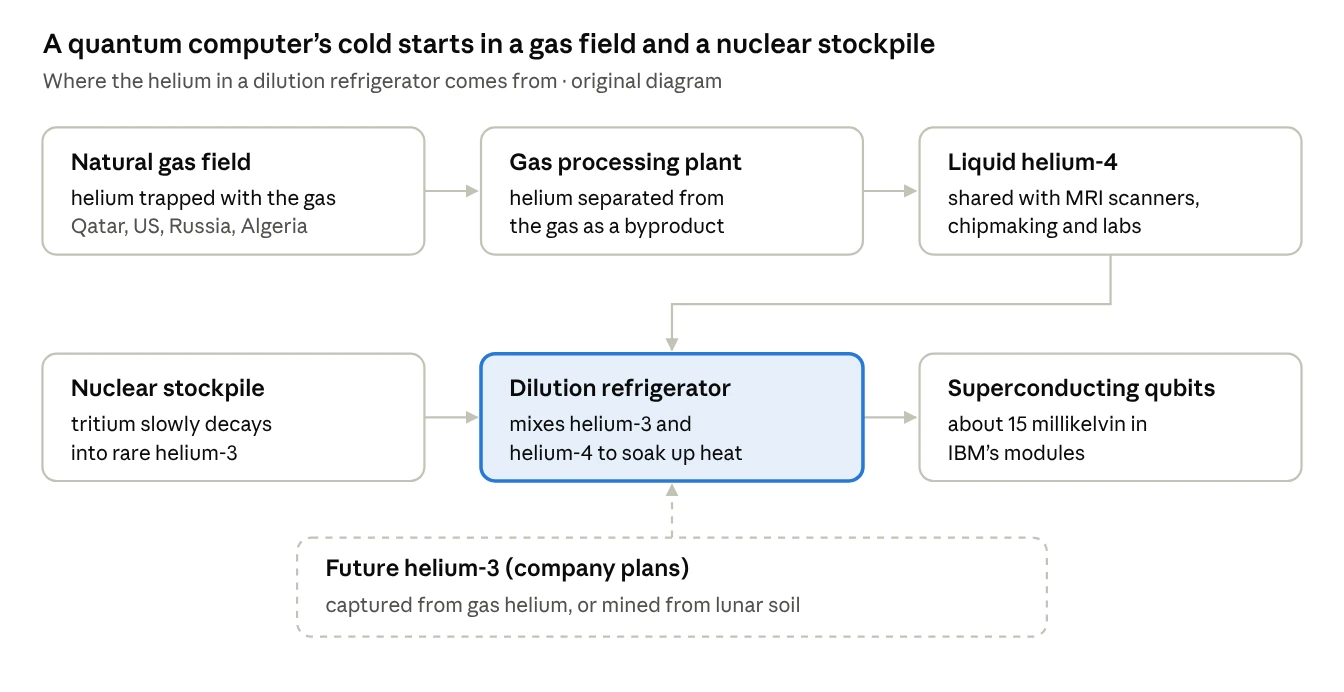
Two very different supply chains, one built on natural gas and one on a nuclear stockpile, meet inside every dilution refrigerator. The dashed box shows sources that companies plan but have not yet delivered at scale.
Imagined futures
The closed-loop quantum center. Edinburgh already recovers most of the helium it uses. A future quantum computing campus could be designed like a sealed terrarium for helium, capturing every liter that boils off and buying fresh gas only to top up small losses.
Gas plants with an isotope sideline. If cryogenic capture of helium-3 works at scale, ordinary helium plants could become a second source of the isotope. The fuel that heats homes would quietly feed the coldest machines on Earth.
Cold as a utility. Instead of one fridge per processor, a quantum data center could run a central cryogenic plant that serves many modules, the way district cooling serves a city block. Fewer, larger machines tend to waste less energy per unit of cold.
Deep cold only where it counts. Some quantum hardware already runs near 1 kelvin on helium-4 alone [13]. Future designs could split the work: control electronics and some qubit types in warmer stages, with the scarce millikelvin cold reserved for the few components that truly need it.
A supply run to the Moon. If lunar extraction ever works, helium-3 might become one of the first resources shipped from the Moon to Earth for commercial use. That would turn quantum computing, of all things, into a customer of space mining.
The last few thousandths of a degree
Go back to the boxes in Poughkeepsie. The coldest spot inside them depends on a gas pulled from the ground with natural gas and an isotope bred in a nuclear stockpile. In 2026, both supply lines proved more fragile than most people knew.
The response is already visible: a federal critical-material designation, scanners that need a fraction of the helium they once did, recovery systems, new isotope sources and coolers that skip helium-3 altogether. None of them solves the problem alone.
The takeaway is simple. Quantum computers are not just a software and physics story. They are an energy and materials story, too. We met the AI decoders that fix a quantum computer's errors in The Quantum Computer's Secret Partner and the chokepoints behind modern technology in The Narrow Waist of Everything. Helium belongs on that map.
Next in the series: the robots now lifting heavy solar panels in the desert and what they mean for the people beside them.
References
All sources were opened and checked on October 28, 2026. Company figures are flagged as company-reported in the text; price estimates are analysts' estimates.
- The Next Platform. IBM pushes system design to reach ultra-cold temperatures for quantum. August 19, 2026.
- US Geological Survey. Mineral Commodity Summaries 2026: Helium. February 2026.
- Gas Processing & LNG. Helium prices soar as Qatar LNG halt exposes fragile supply chain. March 2026.
- NGI (Natural Gas Intelligence). North Field expansion project delays likely as Qatari LNG output crippled by Iranian attacks. March 20, 2026.
- CBS News, 60 Minutes. "Helium is way more important than you might think. And the supply chain is in crisis.". October 18, 2026.
- US Department of Energy. Energy Department designates helium as critical material. October 2026.
- Marketplace. Helium is back on the U.S. list of "critical materials". October 26, 2026.
- US DOE Isotope Program. Supply and demand of helium-3. Undated.
- Manohar Parrikar Institute for Defence Studies and Analyses (IDSA). A helium shock to India's quantum technology ambitions. May 21, 2026.
- Interlune. Interlune produces pure helium-3 from domestic helium using novel cryogenic technology. July 20, 2026.
- Interlune. U.S. Department of Energy buys helium-3 from U.S. space resources company Interlune. May 7, 2025.
- Bluefors. Bluefors to source helium-3 from the Moon with Interlune. September 16, 2025.
- PostQuantum. "Helium-3 Alternatives: Every Exit From the Shortage, Assessed". July 9, 2026.
- ITN (Imaging Technology News). FDA clears Siemens Healthineers 70 cm MAGNETOM Flow platform. January 8, 2026.
- Philips. Philips marks 50 helium-free MRI operations installs in the UK. February 27, 2025.
- Chemistry World. Helium shortages haven't got UK chemistry departments worried yet. 2026.
- Oak Ridge National Laboratory team, Nature Reviews Clean Technology (accepted manuscript via OSTI). Energy and physical resource impacts of quantum computing merit greater attention. 2026.